Why Robotics Needs DevOps
Building a robot is only the beginning. The real challenge is ensuring that robots can be updated, maintained, and scaled reliably over time.
As robotics teams ship new code every day, they face several critical questions:
- How do you ensure new code doesn’t break existing functionality?
- How do you update hundreds of robots without physically accessing them?
- How do you detect issues before they impact customers?
In traditional software, DevOps focuses on accelerating application delivery. In robotics, the stakes are much higher.
Robots operate in the physical world—warehouses, hospitals, factories, and construction sites. A faulty software update doesn’t simply crash an application; it can cause collisions, downtime, operational failures, or even safety risks.
That’s why Robotics DevOps, often referred to as RobotOps, has become one of the most critical disciplines in modern robotics.
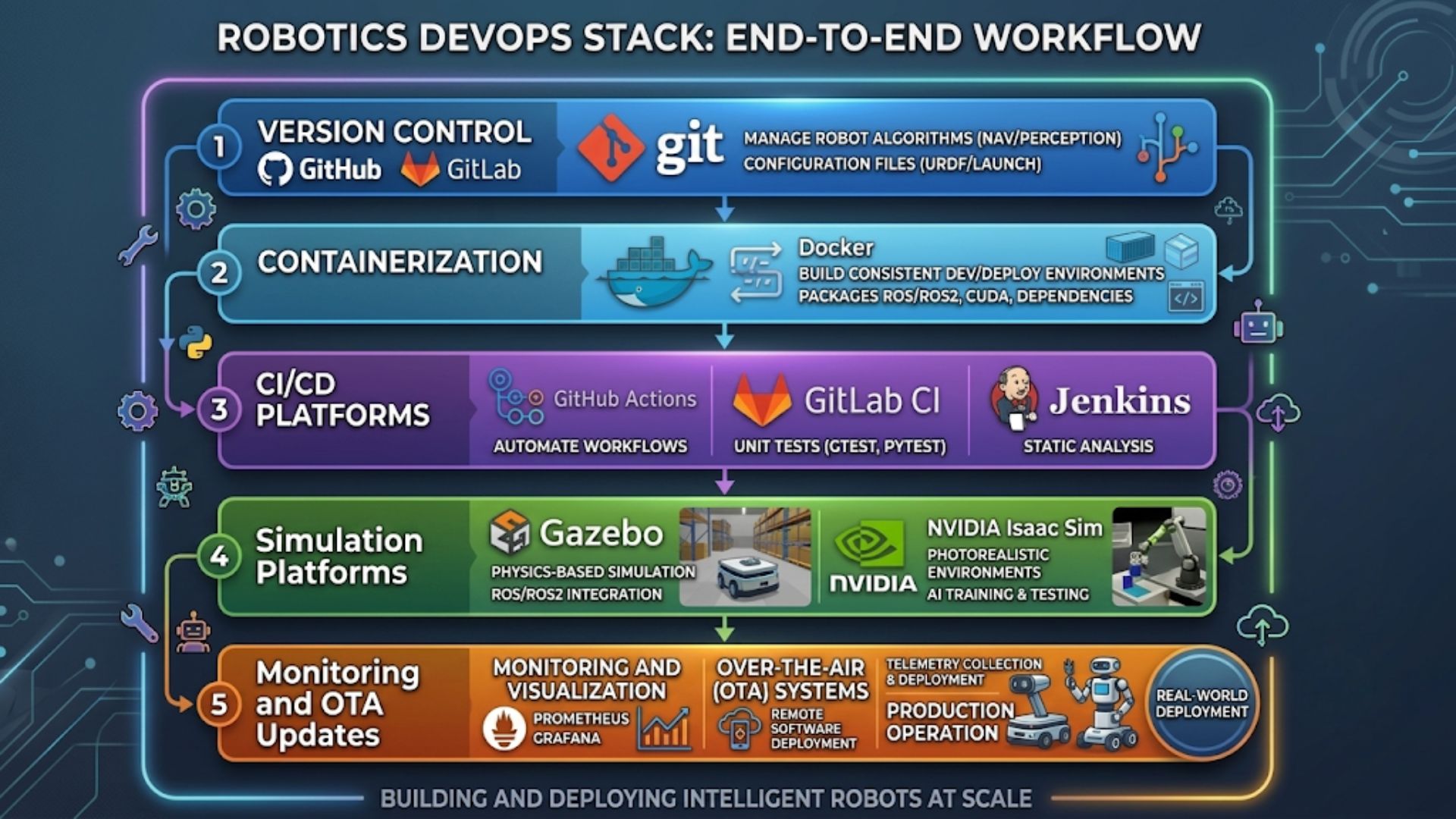
The Core Robotics DevOps Stack
A production-grade robotics DevOps pipeline is built on a set of specialized tools, each serving a specific purpose.
Git: Version Control
Everything starts with Git.
Git provides:
- Source code management
- Complete change history
- Team collaboration and traceability
Every line of code is versioned, and every change is tracked.
Docker: Consistent Development and Deployment
Docker packages robot software and all required dependencies into portable containers.
In development, Docker helps teams:
- Build software consistently
- Run tests in reproducible environments
- Eliminate “works on my machine” issues
In production, the same container can be deployed directly to robot hardware, ensuring consistency across environments.
CI/CD Platforms
Common tools include:
- GitHub Actions
- GitLab CI
- Jenkins
Whenever a developer pushes code, the CI/CD pipeline automatically:
- Builds the software
- Runs code quality checks
- Executes automated tests
- Prepares deployments
This process happens continuously without manual intervention.
Simulation Platforms
Before software reaches real hardware, it is validated in simulation environments such as:
- Gazebo
- NVIDIA Isaac Sim
These platforms accurately model:
- Physics and gravity
- Surface friction
- Sensor noise
- Dynamic environments
Simulation enables teams to verify robot behavior safely before deployment.
Monitoring and OTA Updates
Once robots are deployed, visibility becomes essential.
A typical production setup includes:
- Prometheus for telemetry collection
- Grafana for monitoring and visualization
- OTA (Over-the-Air) systems for remote software deployment
OTA allows companies to update entire robot fleets without visiting a single robot physically.
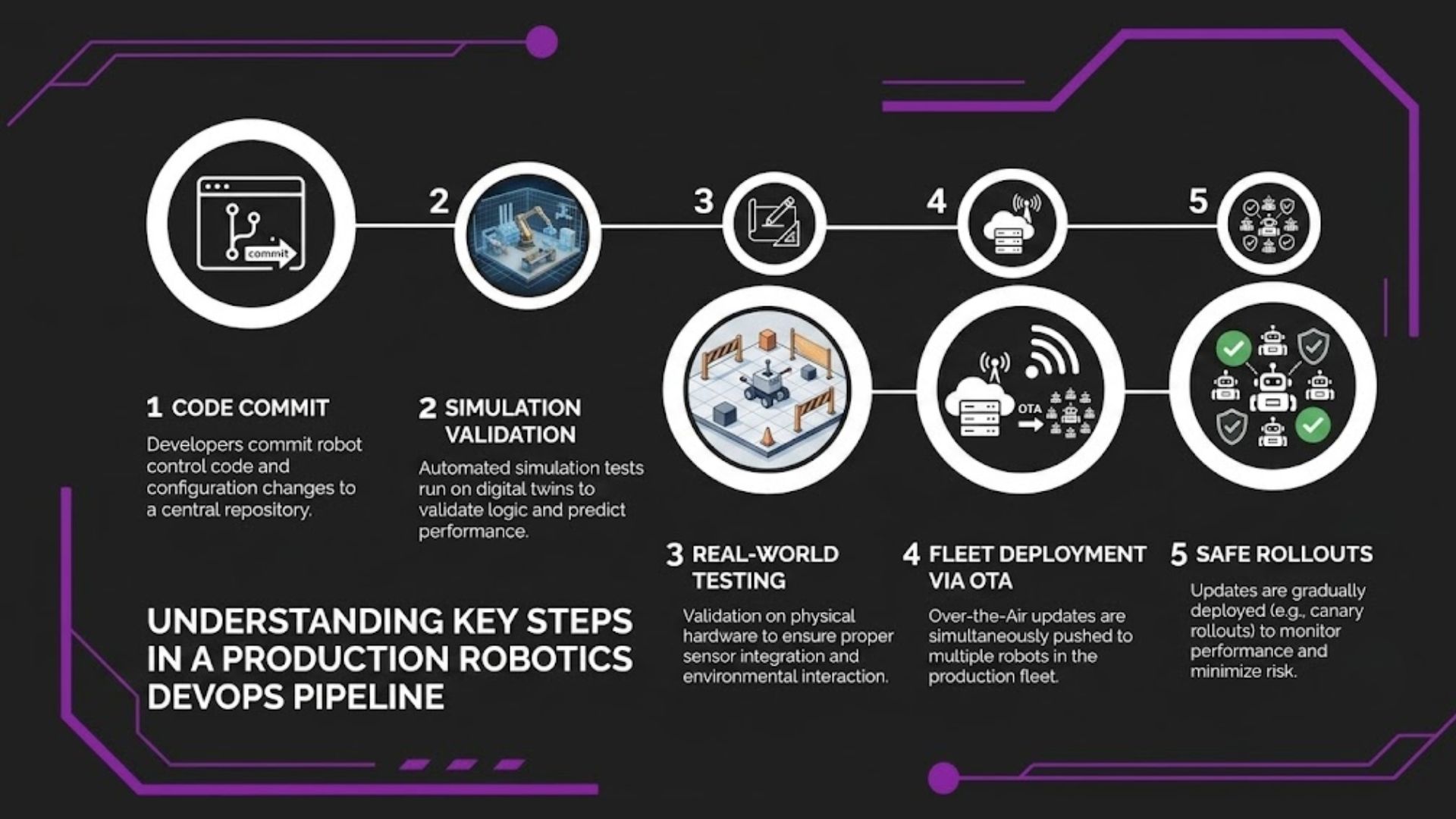
What a Production Robotics DevOps Pipeline Looks Like
Step 1: Code Commit
A developer pushes new code to the Git repository.
This automatically triggers the CI pipeline, which:
- Builds the software
- Runs linting and static analysis
- Executes unit tests
Any issue is identified immediately and sent back to the development team.
Step 2: Simulation Validation
If unit tests pass, the pipeline launches automated simulations in Gazebo or Isaac Sim within Docker containers.
Functional tests verify questions such as:
- Can the robot still navigate correctly?
- Does the robotic arm successfully pick up objects?
- Are sensor readings within acceptable tolerances?
Only validated software moves forward.
Step 3: Real-World Testing
The software is then deployed to a controlled fleet of in-house robots.
This stage catches issues that simulation may miss, including:
- Mechanical wear
- Sensor interference
- Environmental noise
- Hardware-specific edge cases
Failures are discovered internally rather than at customer sites.
Step 4: Fleet Deployment via OTA
After passing all validation stages, the software is deployed to production robots through OTA updates.
At the same time, robots continuously generate telemetry data, including:
- Performance metrics
- Operational status
- Error logs
- Hardware health indicators
Prometheus and Grafana provide real-time visibility into fleet performance and system health.
Step 5: Safe Rollouts
To minimize deployment risk, robotics companies typically use:
Rolling Updates
Software is deployed gradually across the fleet, preventing large-scale downtime.
Canary Releases
New versions are first deployed to a small subset of robots before a full rollout.
This approach allows teams to detect problems early and reduce operational risk.
QA and DevOps: Two Sides of the Same System
Robotics QA and DevOps are deeply interconnected.
A Robotics QA Engineer defines what correct robot behavior looks like by designing:
- Functional tests
- Simulation scenarios
- Validation procedures
The DevOps pipeline ensures those tests run automatically on every code change.
In other words:
QA defines quality. DevOps enforces it continuously.
Together, they create a scalable quality assurance framework that prevents regressions from reaching production robots.
The robotics companies that excel at both QA and DevOps are often the ones delivering reliable products at scale.

cr. Tech Blogs – 42Gears
Conclusion
Modern robotics is no longer just about building robots.
Success depends on the ability to:
- Ship new features quickly
- Update software safely
- Manage large robot fleets
- Maintain reliability at scale
Robotics DevOps is the foundation that makes all of this possible.
As the industry continues to grow, engineers who understand both robotics and DevOps will become increasingly valuable. Building robots is important—but building the systems that keep them running, improving, and scaling is what truly drives long-term success.
If you’re looking to build these skills from the ground up, The Construct’s Robotics Developer Masterclass provides the hands-on training, real-world projects, and portfolio-building experience needed to confidently launch a career in robotics.
The program provides:
- Structured robotics learning paths
- Hands-on real-world projects
- Portfolio-ready systems
- Practical engineering guidance
- Industry-focused training
Instead of spending years wondering what to build next, you’ll follow a clear roadmap designed to help you become job-ready faster.
More Info & Enroll at: roboticsdeveloper.ai