Even if we would like to, engineering students do not receive proper ROS training during their undergraduate period.
This is a problem when students get engaged in the development of the Msc Thesis inside one of the labs of the University, or want to start their PhD. The students must dedicate a long time to get up to speed in ROS, before they can really use the code that is there already.
Typical option for the lab is to provide to the student with a computer, and a link to the ROS Wiki tutorials. Hence the student will pass the days and weeks trying to get the most of it.
Here we propose a smooth learning path for your interns in order to maximize their learning speed. This path is inspired by the book The first 20 hours, and basically consists of four steps:
1. Deconstruct ROS
Deconstructing ROS means to identify the different parts that compose ROS. This work has to be done by somebody that already knows ROS. We have done that work and identified the following main parts:
Installation and setup
Basic organization of the development environment with ROS (catkin workspaces, compilers issues, CMakeLists, IDE configuration)
Basic subjects: packages, roscore, rosparam server
Topics: publishers, subscribers, messages, how to create your own messages
Services: clients, servers, service messages, how to create your own service messages
Actions: clients, servers, service messages, how to create your own action messages
How to make a robot navigate: mapping, localization, path planning and obstacle avoidance
How to make a robot perceive: blob detection with OpenCV, object recognition, point cloud usage, people detection and recognition
Gazebo simulations
URDF robot creation
Robot Control
How to make a robot manipulate objects: MoveIt! usage, combining perception with manipulation, grasping
The previous points cover a global knowledge of ROS. This does not mean that your students will have to learn it all. Those points just express the most common subjects required for the creation of an autonomous robot (like for example the ones used in the Robocup@home competition).
2. Remove stuff
That is, we eliminate as many things as possible, things that are not really necessary right now. The idea is to get the 80% of the results with the 20% of the effort.
C++ or Python?
For the moment, we eliminate the necessity to use C++ for ROS. Using C++ in ROS introduces three problems:
First, the C++ version of ROS includes a lot more of concepts, like the node_handle, the callback_queue or having to deal with the threads of each callback (if you want them in parallel). Python handles all that by itself.
Second, by using Python, the student will have to know just the minimum of CMake handling. Making the proper CMakeLists.txt in C++ is a nightmare. Instead, in Python you almos no need to touch the default one.
Using C++ for ANYTHING, makes the development a lot harder and by hence slower. And here speed is the key. The faster you can close the loop of doing something and experiencing the result, the faster the brain of the student will make the connection that makes him learn the concept. With C++, compilation problems are of the first order.
I know you must be thinking: but C++ is our development language!! They need to learn in that language.
I understand
However, starting their development in C++ is a bad idea, because it makes the pill to swallow a lot bigger. Even if you need the student to use ROS with C+, I recommend you to start with Python (even if the student doesn’t know about Python!!!)
Unless the student is a master of C++, the following path:
Learning Python -> Learning ROS with Python -> Learning ROS with C++
is faster than the path:
Learning ROS with C++
Even if the student already know C++, the additional amount of knowledge required to get ROS using that language makes the evolution very slow.
Installation
The student doesn’t need to know about how to install. Starting with the installation is a waste of time, since at that point the student knows nothing about ROS and may have trouble about the installation. ROS installation is a stupid step, that has nothing to do with ROS or intelligence or knowledge. It is just an experience, that the student will be able to do faster when he already knows ROS.
So we suggest you avoid that step to your students.
How to create a catkin_ws
Again, this is a concept that is difficult to grasp if you don’t know ROS and understand the problems of programming with it. Trying to make the student understand why he has to create a catkin_ws, how to do it and where, is a waste of time. The student will not understand and keep coming to this point once and every time, slowing the progress speed.
Other points to remove
Other points to avoid are, configuring IDEs for programming with ROS (you must provide it done), what is ROS (who cares), how to setup Gazebo (provide it). Basically, you have to remove barriers, physical, emotional and mental, that make the work of learning ROS a lot harder.
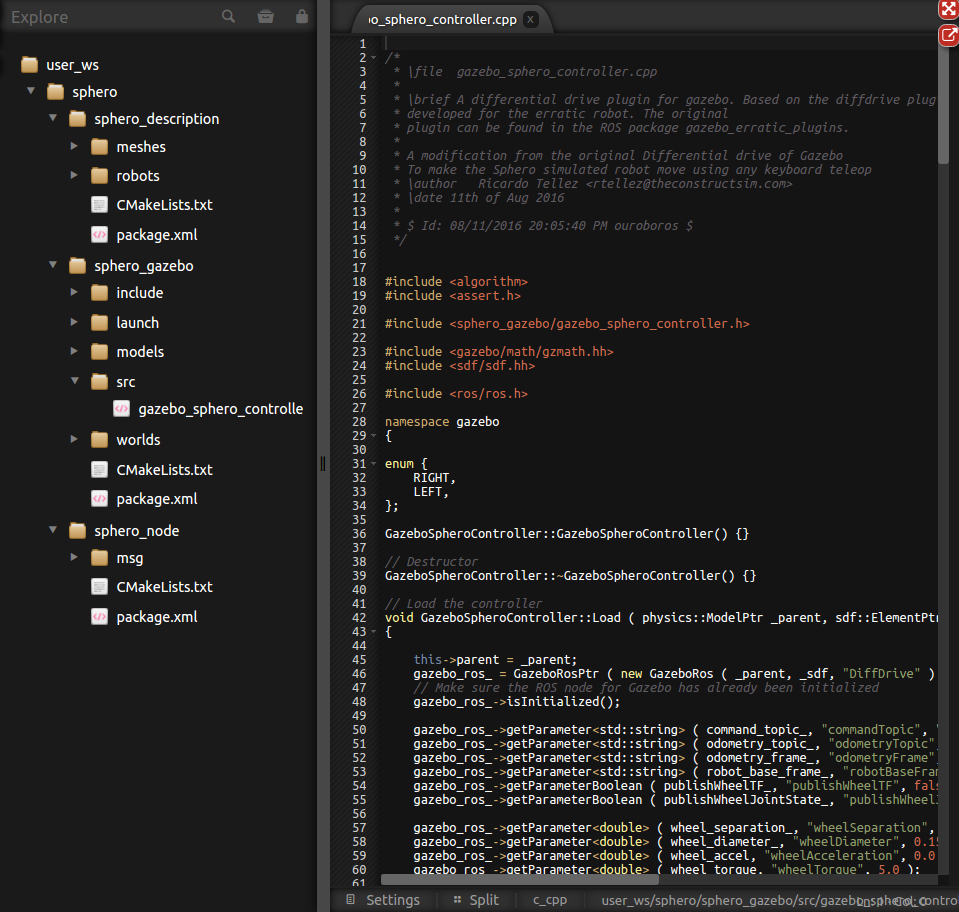
So in this point what we propose is that you have a system already set up and working for the student, and that he concentrates on learning ROS for Python.
3. Learn ROS
Here is were the student has to dedicate the time to learn. But the learning has to be done intelligently, that means, following a proper order and with the option of self-correcting at each step. The faster the self correction is produced, the faster the learning will be.
We propose you to provide to your students with the following sequence of tutorials of ROS (from wiki.ros.org), which we have found to be optimal for faster learning:
In order to learn fast, the student has to practice. Copy + paste of the code of the wiki does not count as practice. Practice means, providing the student with exercises to be solved (without solution provided). The exercises have to be tied to a simulation, so the student can see the results of his efforts quickly and with a meaning. Providing just a number example, for example a topic publishing a text, is not good enough to get the student engaged. And engagement here is key if we want the student to learn quickly. The student will be a lot more motivated if he can see the result of his efforts in a robot. We recommend to provide simulated robots, since they provide the possibility of testing quickly.
Practice should include an exam, if possible. Students learn the most under the stress situation of an evaluation. Sorry, but it works like that (I did not make the rules).
Super important: in order to apply the method and speed up learning, the student has to be practicing at least 20 hours in a row. Dedicating 20 hour focused in the important points will create a momentum that will increase the speed of learning.
Summary
So how can you have your students up to speed with ROS fast? This is a summary of what we have said above:
Provide a fully setup environment. Complete ROS + Gazebo + development IDE installed computer.
Provide the student with the optimal list of tutorials to follow (either the one above of your own), but do not just point the student to the ROS wiki.
Provide a full list of exercises that the student has to solve, without providing the solution.
I know that all that is a lot of work but if you want to invest on that once, you will speed up the process of integration of new students in your lab, and your results will raise.
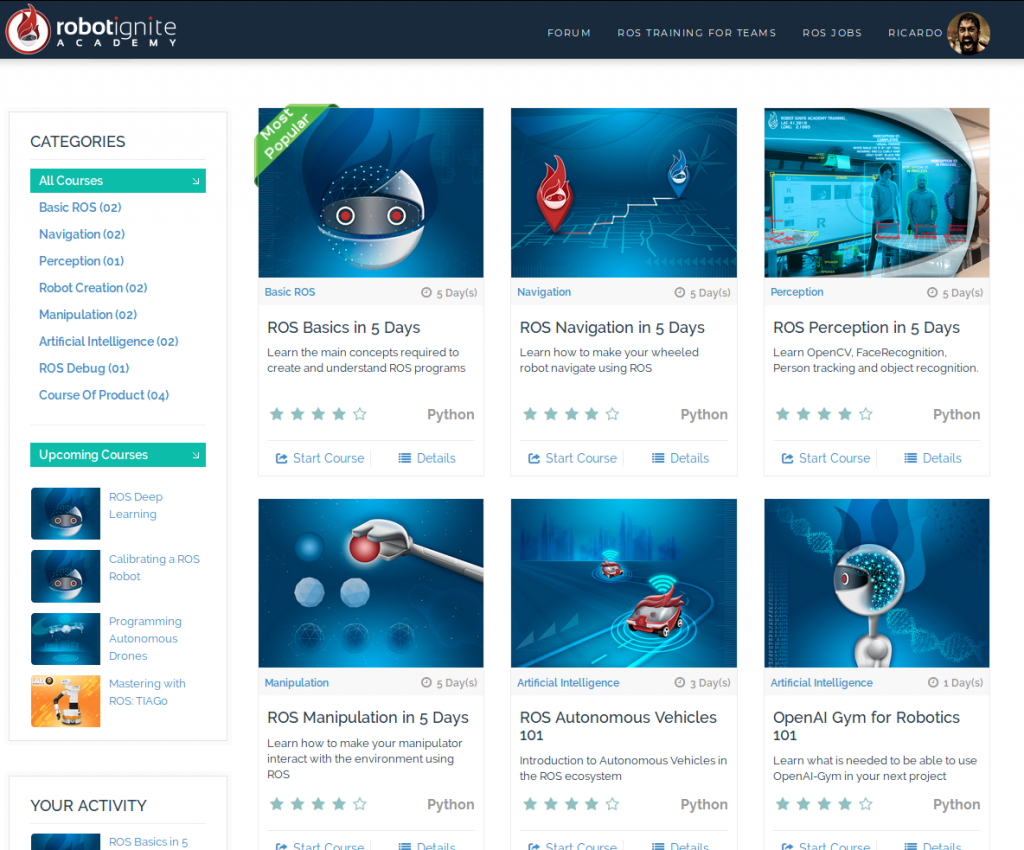
Another option that you have is to use the services of Robot Ignite Academy. In our academy we provide everything already done for your student, organised in the proposed manner, including development environments, robot simulations, exercises and exams. Everything already working, and requiring only a web browser. No installation required, any computer will work. Give it a try!
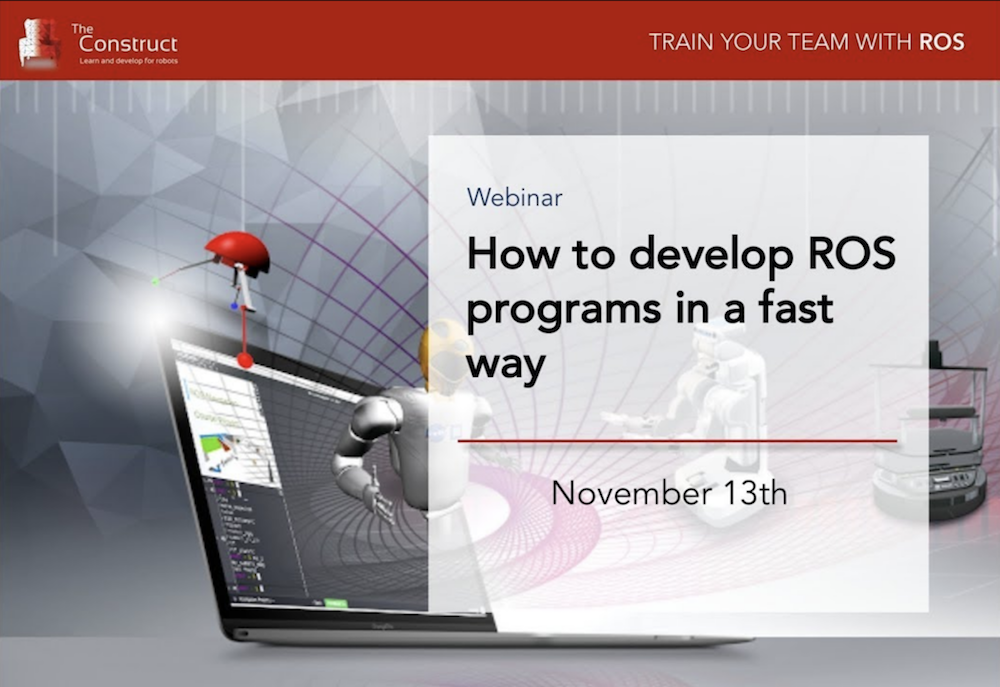
In this webinar we are going to show how to develop your ROS programs in a fast way.
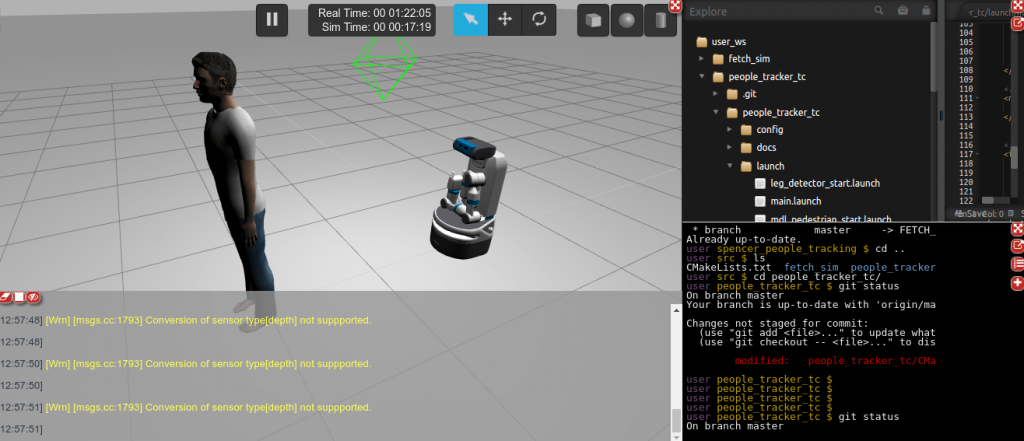
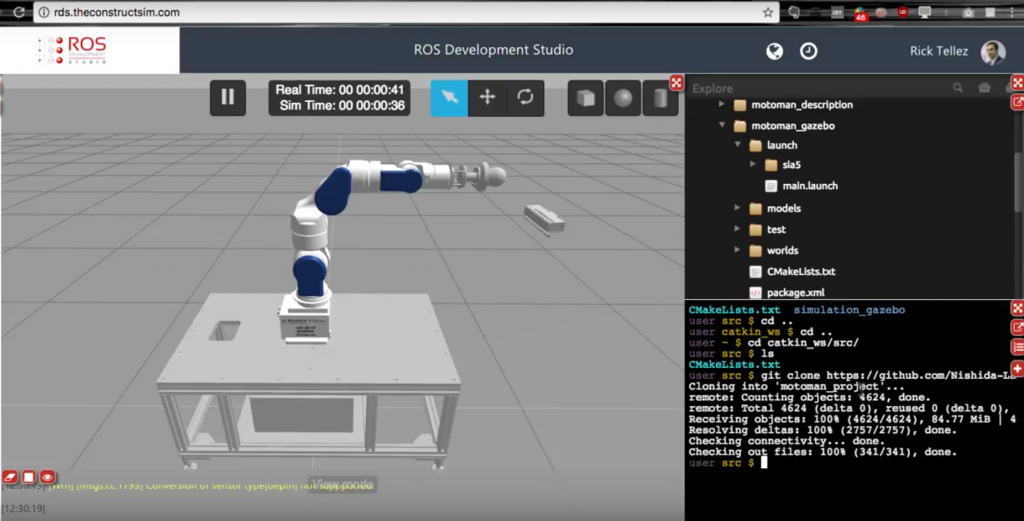
We will be doing a life demo of the ROS Development Studio (RDS), the online web environment that allows development with ROS using any type of computer.
We will show:
1- How to develop a ROS program with RDS using a web browser 2- How to test the program in any of the provided simulations 3- How to debug the program using Rviz and other ROS tools 4- How RDS integrates with git 5- How to use the RDS to create a shareable demo of your product or research result, that others can use off-the-shelf
The presentation will be 20 minutes plus 10 minutes questions.
?Please start watching from 02:20
QUESTIONS ASKED DURING THE WEBINAR THAT WERE NOT RECEIVED BY THE SPEAKER:
* Vamsi Tungala: why simulation time and real-time is different?
Speaker: because the real time is the time we live by, the clock time. The simulation time is the time in the simulation. It may happen that the simulation is very complex and then simulating a second of the robot takes 10 seconds of real time. It could also happen that you use very fast computers and simulate faster that real time.
* Mohamed Abdelkader Zahana: do you need __main__ ?
Speaker: No. No main was required for that example. It was just a simple example. For more complex environments a main definition may be required.
* Sergio Polimante what is the best way, specialy free ways, to learn fast and solid content [of ROS]?
Speaker: I would recommend you to watch this video with the most common methods of learning ROS: https://www.youtube.com/watch?v=udHlvH6TGvo
* Lisset Salinas Pinacho: As this is a web interface, where do the files go? Are they kept in the server?
Speaker: you can leave them there, you can push them to your git, or you can download them using the download option. In the close future there will also be the option to execute on the real robot directly from the platform.
The rapid development of auto-car has promoted a large demand for self-driving cars engineers. Among the skills required, knowing how to program with ROS is becoming an important one. In this webinar you will learn how to start with self-driving cars using ROS.
The aim of this one-hour webinar is to show you
how to change your classes from passive listening to active practising.
Move away from a slides based teaching method to a notebook based one, where direct interaction with robots is embedded in the method itself.
WHO SHOULD ATTEND
Teachers who may need to prepare a syllabus for a summer/winter ROS course, for a future semester, or for a robotics programming course.
We are not going to teach ROS but how to teach ROS for fast learning
HOW TO IMPLEMENT THE THEORY FOR A ROS COURSE
The Notebook-Simulation Approach:
1. Creating the Notebooks
2. Embedding ROS Code in the Notebook
3. Embedding Real-time Graphics in the Notebook
4. Embedding Controls in the Notebook
5. Creating the Gazebo simulations
6. Connecting simulations to notebooks
7. Including projects
8. Including exams
9. Teaching Schedule
In recent years, self-driving car research is becoming the main direction of automotive companies. BMW, Bosch, Google, Baidu, Toyota, GE, Tesla, Ford, Uber, and Volvo are investing in autonomous driving research. Also, many new companies have appeared in the autonomous cars industry: Drive.ai, Cruise, nuTonomy, Waymo to name a few (read this postfor a 260 list of companies involved in the self-driving industry).
The rapid development of this field has promoted a large demand for autonomous-cars engineers. Among the skills required, knowing how to program with ROS is becoming an important one. You just have to visit the robotics-worldwide list to see the large amount of job offers for working/researching in autonomous cars, which demand knowledge of ROS.
Why ROS is interesting for Autonomous Cars
Robot Operating System (ROS) is a mature and flexible framework for robotics programming. ROS provides the required tools to easily access sensors data, process that data, and generate an appropriate response for the motors and other actuators of the robot. The whole ROS system has been designed to be fully distributed in terms of computation, so different computers can take part in the control processes, and act together as a single entity (the robot).
Due to those characteristics, ROS is a perfect tool for self-driving cars. After all, an autonomous vehicle can be considered just as another type of robot, so the same types of programs can be used to control them. ROS is interesting for autonomous cars because:
There is a lot of code for autonomous cars already created. Autonomous cars require the creation of algorithms that are able to build a map, localize the robot using lidars or GPS, plan paths along maps, avoid obstacles, process pointclouds or cameras data to extract information, etc… All kind of algorithms required for the navigation of wheeled robots is almost directly applicable to autonomous cars. Hence, since those algorithms have already been created in ROS, self-driving cars can just make use of them off-the-shelf.
Visualization tools already available. ROS has created a suite of graphical tools that allow the easy recording and visualization of data captured by the sensors, and represent the status of the vehicle in a comprehensive manner. Also, it provides a simple way to create additional visualizations required for particular needs. This is tremendously useful when developing the control software and trying to debug the code.
It is relatively simple to start an autonomous car project with ROS onboard. You can start right now with a simple wheeled robot equipped with a pair of wheels, a camera, a laser scanner, and the ROS navigation stack, and you are set up in a few hours. That could serve as a basis to understand how the whole thing works. Then you can move to more professional setups, like for example, buying a car that is already prepared for autonomous car experiments, with full ROS support (like the Dataspeed Inc. Lincoln MKZ DBW kit).
Self-driving cars companies have realized those advantages and have started to use ROS in their developments. Examples of companies using ROS include BMW (watch their presentation at ROSCON 2015), Bosch or nuTonomy.
Weak points of using ROS
ROS is not all nice and good. At present, ROS presents two important drawbacks for autonomous vehicles:
Single point of failure. All ROS applications rely on a software component called the roscore. That component, provided by ROS itself, is in charge of handling all coordination between the different parts of the ROS application. If the component fails, then the whole ROS system goes down. This implies that it does not matter how well your ROS application has been constructed. If roscore dies, your application dies.
ROS is not secure. The current version of ROS does not implement any security mechanism for preventing third parties to get into the ROS network and read the communication between nodes. This implies that anybody with access to the network of the car can get into the ROS messaging and kidnap the car behavior.
All those drawbacks are expected to be solved in the newest version of ROS, the ROS 2.Open Robotics, the creators of ROS have recently released a second beta of ROS 2 which can be tested here. It is expected to have a release version by the end of 2017.
In any case, we believe that the ROS based path to self-driving vehicles is the way to go. That is why, we propose a low budget learning path for becoming a self-driving car engineer, based on the ROS framework.
Our low-cost path for becoming a self-driving cars engineer
Step 1
First thing you need is to learn ROS. ROS is quite a complex framework to learn and requires dedication and effort. Watch the following video for a list of the 5 best methods to learn ROS. Learning basic ROS will help you understand how to create programs with that framework, and how to reuse programs made by others.
[irp posts=”6110″ name=”5 methods for learning ROS: which one is for you?”]
Step 2
Next, you need to get familiar with the basic concepts of robot navigation with ROS. Learning how the ROS navigation stack works will provide you the knowledge of basic concepts of navigation like mapping, path planning or sensor fusion. There is no better way to learn this than taking the ROS Navigation in 5 days course developed by Robot Ignite Academy.
Step 3
Third step would be to learn the basic ROS application to autonomous cars: how to use the sensors available in any standard of autonomous car, how to navigate using a GPS, how to generate an algorithm for obstacle detection based on the sensors data, how to interface ROS with the Can-bus protocol used in all the cars used in the industry…
The following video tutorial is ideal to start learning ROS applied to Autonomous Vehicles from zero. The course teaches how to program a car with ROS for autonomous navigation by using an autonomous car simulation. The video is available for free, but if you want to get the most of it, we recommend you to do the exercises at the same time by enrolling the Robot Ignite Academy (additionally, in case you like it, you can use the discount coupon 99B9A9D8 for a 10% discount).
Step 4
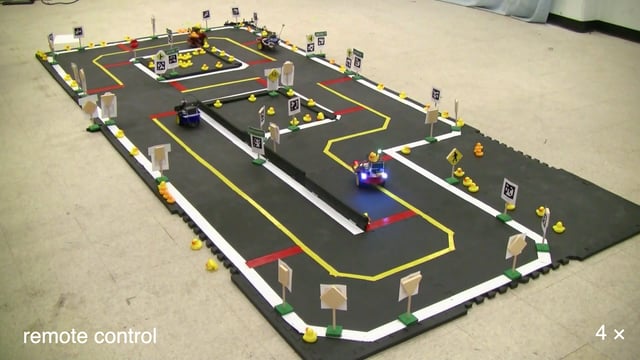
After the basic ROS for Autonomous Cars course, you should learn more advanced subjects like obstacles and traffic signals identification, road following, as well as coordination of vehicles in crossroads. For that purpose, our recommendation would be to use the Duckietown project. That project provides complete instructions to physically build a small size town, with lanes, traffic lights and traffic signals, where to perform real practice of algorithms (even if at a small scale). It also provides instructions to build the autonomous cars that should populate the town. Cars are based on differential drives and a single camera for sensors. That is why they achieve a very low cost (around 100$ per each car).
Image by Duckietown project
Due to the low economical requirements, and to the good experience that it may be for testing real stuff, the Duckietown project is ideal for start practicing some autonomous cars concepts like line following based on vision, other cars detection, traffic signals based behavior. Still, if your budget is even below that cost, you can use a Gazebo simulation of the Duckietown, and still be able to practice most of the content.
Step 5
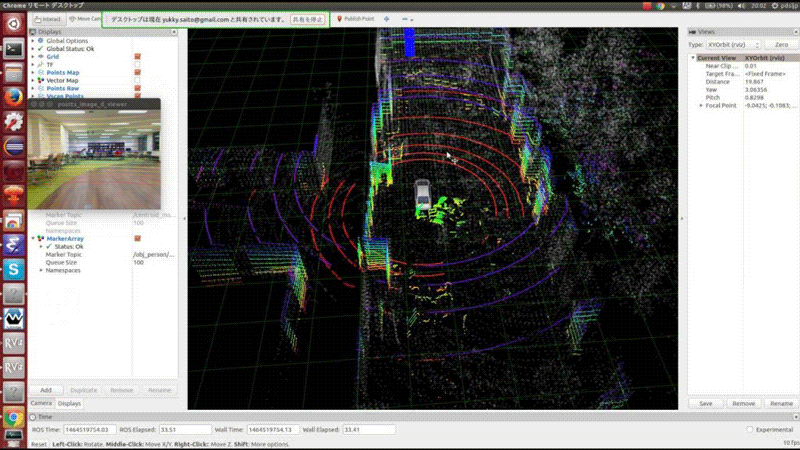
Then if you really want to go pro, you need to practice with real-life data. For that purpose, we propose you to install and learn the Autoware project. This project provides real data obtained from real cars on real streets, by means of ROS bags. ROS bags are logs containing data captured from sensors which can be used in ROS programs as if the programs were connected to the real car. By using those bags, you will be able to test algorithms as if you had an autonomous car to practice with (the only limitation is that the data is always the same and restricted to the situation that happened when it was recorded).
Image by the Autoware project
The Autoware project is an amazing huge project that, apart from the ROS bags, provides multiple state-of-the-art algorithms for localization, mapping, obstacles detection and identification using deep learning. It is a little bit complex and huge, but definitely worth studying for a deeper understanding of ROS with autonomous vehicles. I recommend you to watch the Autoware ROSCON2017 presentation for an overview of the system (will be available in October 2017).
Step 6
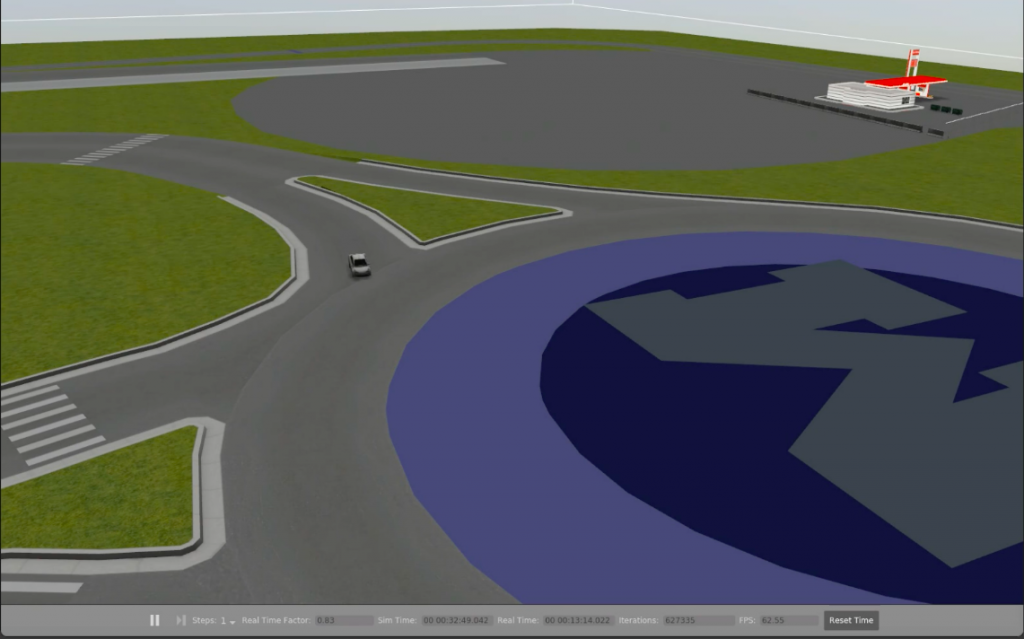
The final step would be to start implementing your own ROS algorithms for autonomous cars and test them in different, close to real situations. The previous step provided you with real-life situations, but always fixed for the moment the bags were recorded. Now it is time that you test your algorithms in more different situations. You can use already existing algorithms in a mix of all the steps above, but at some point, you will see that all those implementations lack some things required for your goals. You will have to start developing your own algorithms, and you will need lots of tests. For this purpose, one of the best options is to use a Gazebo simulation of an autonomous car as a testbed of your ROS algorithms. Recently, Open Robotics has released a simulation of cars for Gazebo 8 simulator.
Image by the Open Robotics
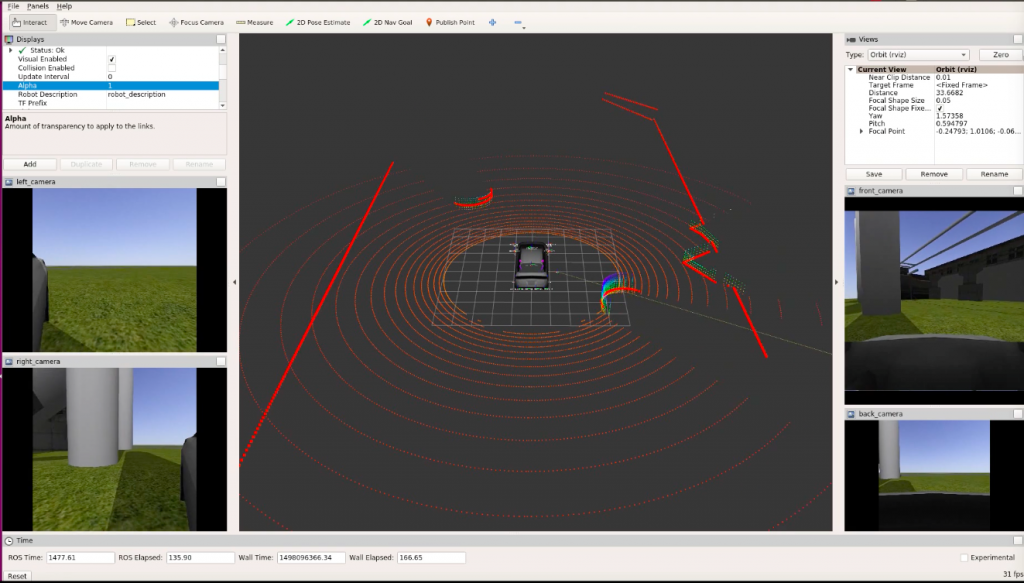
That simulation, based on ROS contains a Prius car model, together with 16 beam lidar on the roof, 8 ultrasonic sensors, 4 cameras, and 2 planar lidar, which you can use to practice and create your own self-driving car algorithms. By using that simulation, you will be able to put the car in as many different situations as you want, checking if your algorithm works on those situations, and repeat as many times as you want until it works.
Conclusion
Autonomous cars is an exciting subject whose demand for experienced engineers is increasing year after year. ROS is one of the best options to quickly jump into the subject. So learning ROS for self-driving vehicles is becoming an important skill for engineers. We have presented here a full path to learn ROS for autonomous vehicles while keeping the budget low. Now it is your time to do the effort and learn. Money is not an excuse anymore. Go for it!
Course
ROS Autonomous Vehicles 101
Introduction to Autonomous Vehicles in the ROS Ecosystem
Last week I was talking to one lead engineer of a Singapore company which is building a benchmarking system for robot solutions. Having seen my presentation at ROSCON2016 about robot benchmarking, he asked me how would I benchmark solutions that are non-ROS compatible. I said that I wouldn’t. I would not dedicate time to benchmark solutions that are not ROS based. Instead, I suggested, I would use the time to polish the ROS-based benchmarking and suggest the vendors to adopt that middleware in their products.
Benchmarks are necessary and they need standards
Benchmarks are necessary in order to improve any field. By having a benchmark, different solutions to a single problem can be compared and hence a direction for improvement can be traced. Up to the present, robotics lacks such benchmarking system.
I strongly believe that in order to create a benchmark for robotics we need a standard at the level of programming.
By having a standard at the level of programming, manufacturers can build their own hardware solutions at will, as far as they are programmable with the programming standard. That is the approach taken by devices that can be plugged into a computer. Manufacturers create the product on their own terms, and then provide a Windows driver that allows any computer in the world (that runs on the Windows standard) to communicate with the product. Once this communication computer-to-product is made, you can create (Windows) programs that compare the same type of devices (from different manufacturers) for performance, quality, noise, whatever your benchmark is trying to compare.
You see? Different types of devices, different types of hardware. But all of them can be compared through the same benchmarking system that relies on the Windows standard.
Software development for robots also needs standards
The need for standards is not only required for comparing solutions but also to speed robotics development. By having a robotics standard, developers can concentrate on building solutions that do not have to be re-implemented whenever the robot hardware changes. Actually, given the middleware structure, developers can disassociate so much from the hardware that they can almost rely 100% of its time in the software realm while developing for robotics (something that software developers like very much, to be away from the hardware. Actually, this is one of the reasons why so few good software developers exists in robotics (most of us are a mix of hardware and software… now you understand the current state of AI for robotics ;-)).
We need the same type of standard for robotics. We need a kind of operating system that allows us to compare different robotics solutions. We need the Windows of the PCs, the Android of the phones, the CAN of the buses…
A few standard proposals and a winner
But you already know that. I’m not the first one to state this. Actually, there have been many people already that tried to create such standard. Some examples include Player, ROS, YARP, OROCOS, Urbi, MIRA or JdE Robot, to name a few.
Personally, I actually don’t care which the standard is. It could be ROS, it could be YARP or it could be any other that still has not been created. The only thing I really care is that we adopt a standard as soon as possible.
And it looks like the developers have decided. Robotics developers prefer ROS as their common middleware to program robots with.
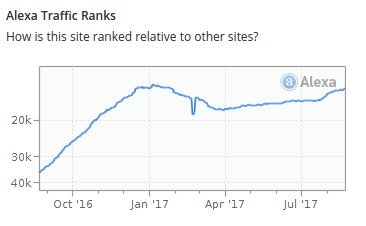
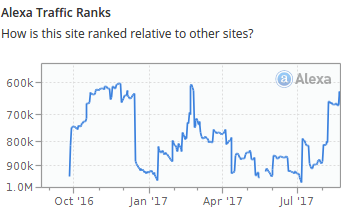
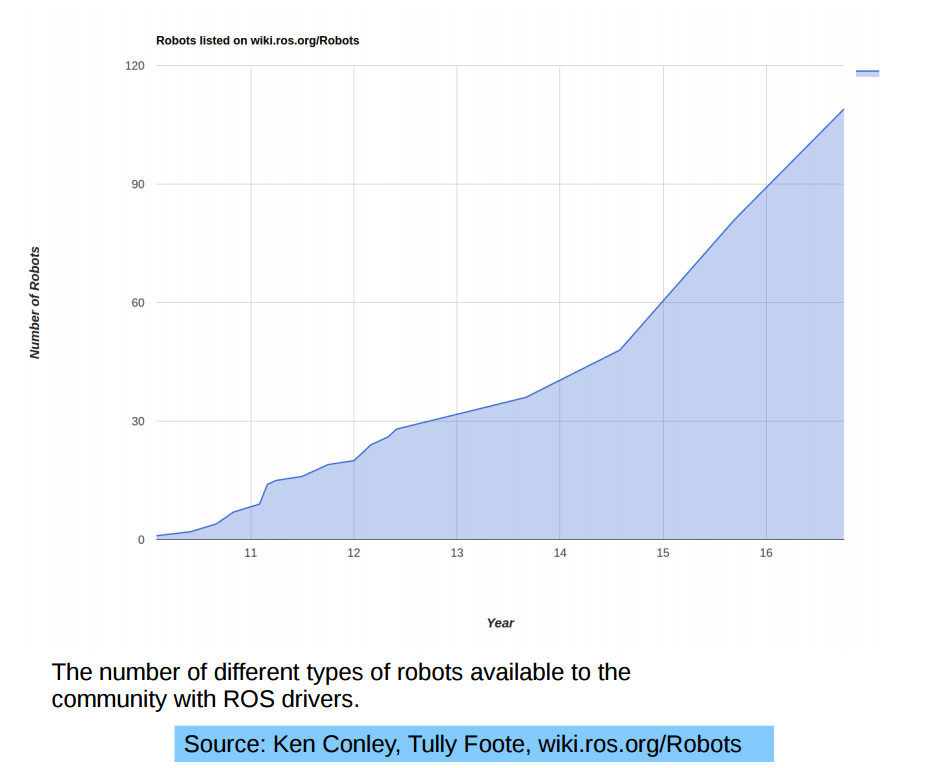
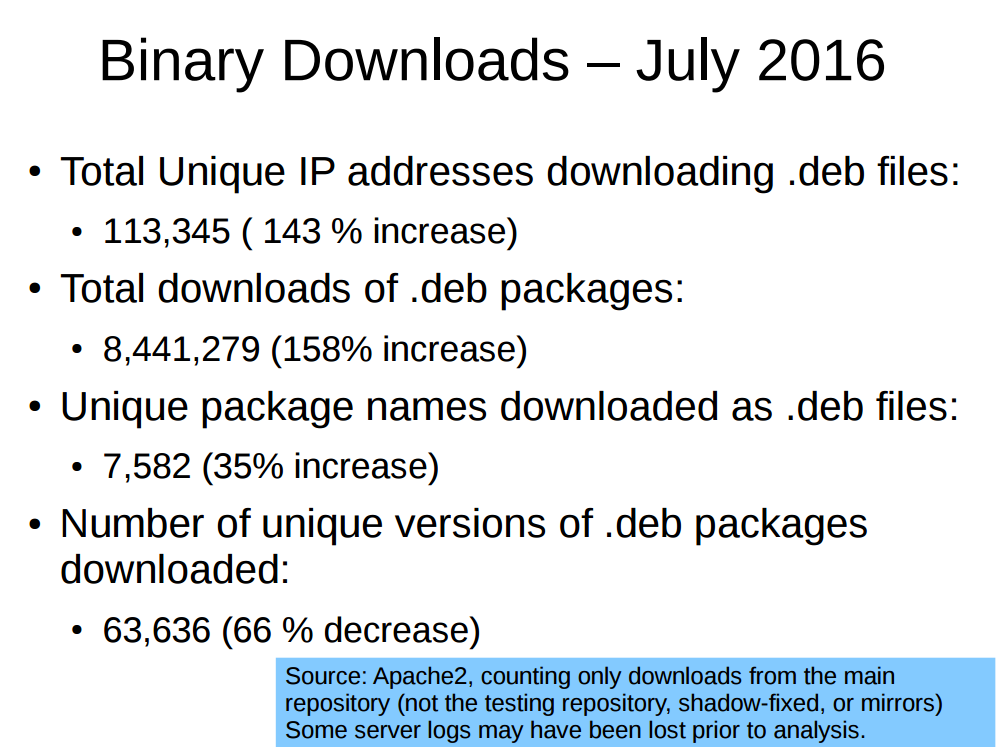
No other middleware for robotics has had so large adoption. Some data about it:
Note 1: Only showing the current big three players
Note 2: Very simple comparison. Difficult to compare in other terms since data is not available
Note 3: Data measured in August 2017. May vary at the time you are reading this. Links provided on the numbers themselves, so you can check by yourself.
So it is not only the feeling that we, roboticists, have. Also the numbers indicate that ROS is becoming that standard for robotics programming.
Why ROS?
The question is then, why has ROS emerged on top of all the other possible contestants. None of them is worst than ROS in terms of features. Actually you can find some feature in all the other middlewares that outperform ROS. If that is so, why or how has ROS achieved the status of becoming the standard ?
A simple answer from my point of view: excellent learning tutorials and debugging tools.
Here there is a video where Leila Takayama, early developer of ROS, explains when she realized that the key for having ROS used worldwide would be to provide tools that simplify the reuse of ROS code. None of the other projects have such a set of clear and structured tutorials. Even less, those other middlewares provide debugging tools into their packages. Lacking those two essential points are preventing new people to use their middlewares (even if I understand the developers of OROCOS and YARP for not providing it… who wants to write tutorials or build debugging tools… nobody! 😉 )
Additionally, it is not only about Tutorials and Debugging-Tools. ROS creators also managed to create a good system of managing packages. The result of that is that developers worldwide could use others packages in a (relatively) easy way. This created an explosion in ROS packages available, providing off-the-shelf almost anything for your brand new ROSified robot.
Now, the rate at which contributions to the ROS ecosystem are made is so big that makes ROS almost unstoppable in terms of growing.
What about companies?
At the beginning, ROS was mostly used by students at Universities. However, as ROS becomes more mature and the number of packages increases, companies are realizing that adopting ROS is also good for them because they will be able to use the code developed by others. On top of that, it will be easier for them to hire new engineers already knowing the middleware (otherwise they would need to teach the newcomers their own middleware).
To bring things further, two Spanish companies have revolutioned the standarization of robotics products towards the ROS middleware: in one side, Robotnik has created the ROS Components shop. A shop where anyone can buy ROS compatible devices, starting from mobile bases to sensors or actuators. On the other side, Erle Robotics (now Acutronic Robotics) is in the process of developing Hardware ROS. The H-ROS is a standardized software and hardware infrastructure to easily create reusable and reconfigurable robot hardware parts. ROS is taking the hardware standarization too! But this time is made by companies, not research! That must mean something…
Finally, it looks like industrial robots manufacturers have understood the value that a standard can provide to their business. Even if they do not build their industrial robots ROS enabled from scratch, they are adopting the ROS Industrial flavour of ROS, which allows them to ROSify their industrial robots and re-use all the software created for manipulators in the ROS ecosystem.
But are all companies getting into the ROS bus? Not all of them!
Some companies like Jibo, Aldebaran or Google still do not rely on ROS for their robots programming. Some of them rely on their own middleware created previously to the existence of ROS (that is the case of Aldebaran). Some others, though, are creating their own middleware from scratch. Their reasons: do not believe ROS is good, they have already created a middleware, or do not want to develop their products depending on the middleware of others. Those companies have very fair reasons to go their way. However, will that make them competitive? (if we have to judge from previous history, mobiles, VCRs, the answer may be no).
So is ROS the standard for programming robots?
That is a question still too soon to be answered. It looks like it is becoming the standard, but many things can change. It is unlikely that another middleware takes the current number one middleware title from ROS. But it may happen something that wipes ROS out of the map (may be Google will release its middleware to the public (like they did with Android) and take the sector by storm?).
Still, ROS has its problems, like a total lack of security or the instability of some important packages. Even if the OSRF group are working hard to build a better ROS system (for instance ROS2 is in beta phase with many root improvements), some hard work is still required for some basic things (like the ROS controllers for real robots).
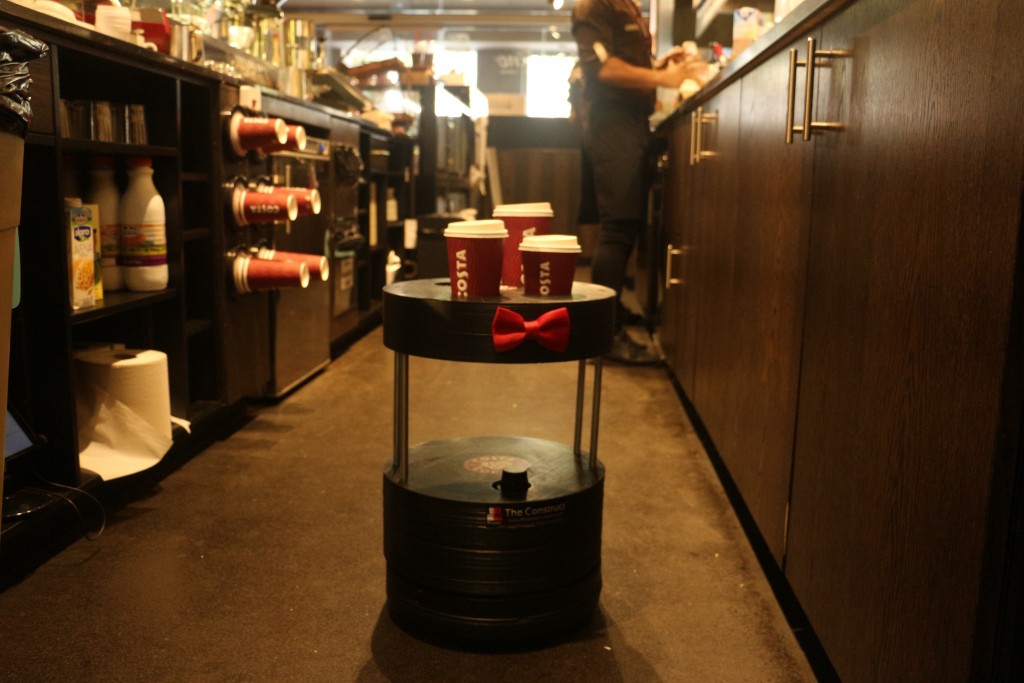
Given those numbers, at The Construct we believe that ROS IS THE STANDARD (that is why we are devoted to creating the best ROS learning tutorials of the world). Actually, it was thanks to this standardization that two Barcelona students were able to create an autonomous robot product for coffee shops in only three months from zero knowledge of robotics (see Barista robot).
This is the future that is coming, and it is good. On that future, thanks to standards, almost anyone will be able to build, design and program their own robotics product, in a similar way as PC stores are building computers today.
So my advice, as I said to the Singapore engineer, is to bet for ROS. Right now, it is the best option for a robotics standard.