If you’re aiming for a career in robotics engineering, you’ve probably heard that high-level tools, low-code platforms, and AI-assisted development are the future.
And that’s true—to a certain extent.
But there’s a hard truth every aspiring robotics engineer needs to understand early:
If you want to build production-ready robots that reliably operate in the real world, C++ is not optional.
It’s a non-negotiable requirement.
Even with AI helping us generate code faster than ever, deep C++ knowledge remains one of the most important skills robotics companies look for when hiring engineers. And honestly, I don’t expect that requirement to disappear anytime soon.
In fact, the opposite may happen:
The more we rely on AI to generate code, the more critical it becomes to understand what’s happening underneath the hood—because AI-generated errors are becoming increasingly complex.
The Problem With How Most Developers Learn C++
Many developers stop learning C++ far too early.
They learn:
How to write functions
How classes work
Basic inheritance
Some object-oriented programming concepts
And then assume they’re “ready.”
But robotics companies are not hiring engineers based on basic syntax knowledge.
They care about whether you can handle:
Multi-threading
Memory management
Smart pointers
Lambda expressions
Real-time performance constraints
System architecture decisions
Concurrency and synchronization
Because robotics is not traditional software development.
Robots interact with the physical world.
That means:
Sensor data must be processed in real time
Control loops need millisecond-level responsiveness
Multiple systems must run concurrently
Memory leaks can crash entire systems
One blocked thread can break robot behavior
In these high-stakes environments, relying on AI-generated “good enough” code without understanding what’s happening internally is simply not enough.
AI can help you write code faster.
But it cannot replace engineering judgment.
You still need to understand:
Why certain architectural decisions matter
How memory is allocated and released
How threads communicate safely
Where bottlenecks come from
How to build scalable and maintainable systems
To Reach Industry Level, You Must Go Deep Into Modern C++
If you truly want to become an industry-level robotics engineer, you need to master Modern C++ deeply.
Not just enough to “use it,” but enough to understand:
How smart pointers work internally
The cost of virtual functions
RAII principles
Move semantics
Thread synchronization
Object lifetime management
Performance optimization techniques
These are the skills that separate:
Hobbyists
Junior developers
Senior robotics engineers
And this depth matters even more in robotics, where performance and reliability directly impact real-world behavior.
How to Actually Improve Your C++ Skills
1. Study Modern C++ Systematically
A great place to start is with a robotics-focused Modern C++ course.
If you don’t know where to start, our Robotics Developer Masterclass program is designed to help you build the exact skills, projects, and portfolio needed to enter the robotics job market confidently.
The program provides:
Structured robotics learning paths
Hands-on real-world projects
Portfolio-ready systems
Practical engineering guidance
Industry-focused training
Instead of spending years wondering what to build next, you’ll follow a clear roadmap designed to help you become job-ready faster.
If you’re a robotics engineer or aspiring developer, you’ve probably realized one thing already: landing a robotics job is not easy.
The competition is intense, the expectations are high, and companies are becoming increasingly selective about who they hire. But here’s the reality many people still don’t understand:
When a company hires someone to build a real-world robotic system, they are not simply hiring a diploma. They are hiring proof of capability.
They want the engineer who has already integrated sensors into a working system, written production-level code, debugged communication failures at 2 AM, and dealt with the messy, unpredictable nature of real hardware.
In robotics, theory alone is no longer enough.
The Problem With the Traditional Path
For years, students were told that earning a degree was the key to securing a good engineering job. While education still matters, the robotics industry is changing rapidly.
Most university programs focus heavily on theoretical concepts while offering only limited exposure to real-world robotics development. Students graduate understanding equations, algorithms, and frameworks — but often without experience solving practical engineering problems under real constraints.
At the same time, hiring managers are overwhelmed with nearly identical resumes. Many look impressive on paper, filled with certifications, buzzwords, and polished descriptions. But increasingly, those resumes fail to demonstrate actual engineering ability.
The result?
Employers struggle to distinguish between someone who truly knows how to build robotic systems and someone who simply knows how to talk about them.
Why Portfolios Matter More Than Ever
If you want to stand out in today’s robotics market, you must show your work.
A strong digital portfolio has become one of the most valuable assets a robotics engineer can have. Whether it’s a GitHub repository, a personal website, or both, your portfolio acts as your technical showcase.
And the best time to start building it is now.
Don’t just create a list of skills and technologies. Anyone can write “ROS,” “Computer Vision,” or “Embedded Systems” on a resume. What matters is demonstrating how you actually used them.
Document your robotics projects properly:
Share videos of your robots in action
Upload the real code you wrote
Explain your system architecture
Describe the challenges you faced
Show how you solved hardware and software issues
Most importantly, explain your engineering decisions.
Why did you choose that sensor instead of another one? How did you solve communication latency? What tradeoffs did you make between cost, performance, and reliability?
This is the kind of information that proves expertise to hiring managers.
No Projects Yet? Start Today.
Many aspiring robotics engineers hesitate because they feel they are “not ready” to build something.
That mindset is holding them back.
If you haven’t completed a real robotics project yet, start immediately. Search for robotics projects on YouTube, pick one that interests you, and try to replicate it.
You do not need to invent the next humanoid robot from scratch.
The goal is to learn by building.
As you improve the project, customize it, optimize it, and document the process, you begin developing the exact practical skills companies are searching for.
And yes — include those projects in your portfolio.
The One Important Exception
There is, however, one major exception to this advice.
If your goal is not industry engineering but robotics research, then formal academic credentials still play a critical role.
Research exists at the frontier of what’s possible. Advancing robotics science often requires deep theoretical specialization, academic publications, and access to research institutions.
For that path, a PhD remains the standard requirement.
But for most people pursuing robotics careers in industry, execution matters far more than certificates.
Whether you create a simple mobile robot, an autonomous drone, or a complex robotic arm, your ability to execute, solve problems, and document your work is what separates you from the crowd.
Build projects. Share them publicly. Explain your process. Demonstrate your thinking.
Because in robotics, your portfolio is your real degree!
Ready to Break Into Robotics Faster?
If you don’t know where to start, our Robotics Developer Masterclass program is designed to help you build the exact skills, projects, and portfolio needed to enter the robotics job market confidently.
The program provides:
Structured robotics learning paths
Hands-on real-world projects
Portfolio-ready systems
Practical engineering guidance
Industry-focused training
Instead of spending years wondering what to build next, you’ll follow a clear roadmap designed to help you become job-ready faster.
Your robotics portfolio is where you really demonstrate your robotics level.
As we evolve, recruiters are focusing more on roboticists that show their portfolio rather than their CV.
Forget about diplomas. Forget about certificates. Show your portfolio!
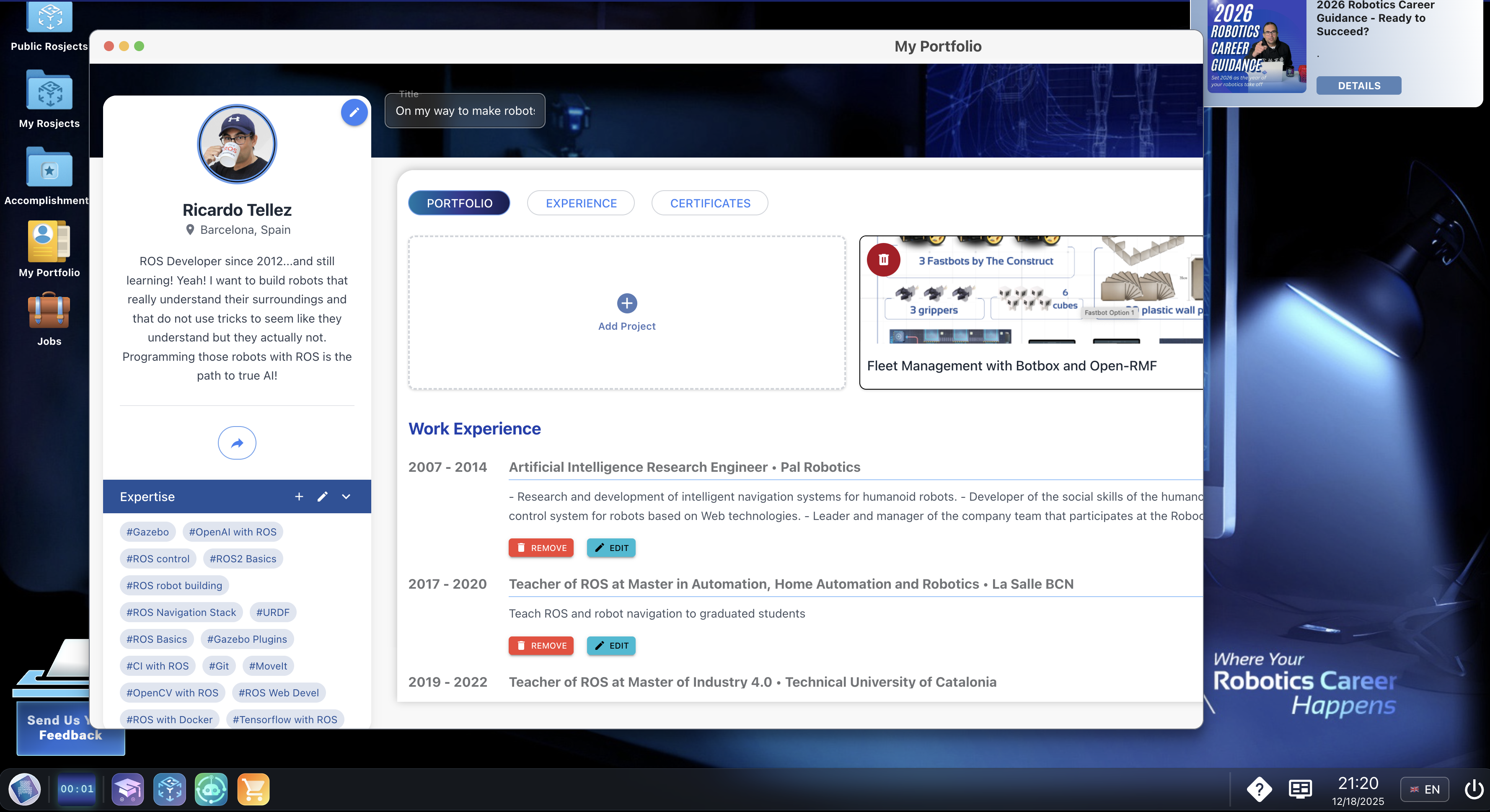
What is a portfolio?
Your portfolio should be a dedicated website listing the main robotics projects you have developed.
You can host it wherever you want: your personal website, within GitHub, inside The Construct platform… The hosting location doesn’t matter as long as it is available worldwide.
Here some advices about how to build a professional portfolio:
1. Focus on quality over quantity
Recruiters don’t have time to wade through twenty mediocre projects. Focus your efforts on 3 to 5 truly impressive, well-documented projects that show a wide range of skills.
In robotics, the kind of projects that you can show are:
Project Type
What it Demonstrates
Examples
Hardware Integration
Ability to work with sensors, actuators, wiring, and real-world constraints.
Building a custom PCB for a mobile robot, creating a PID controller for a motor or even building full robots
Complex Software/Algorithms
Proficiency in high-level programming, math, and specific robotics concepts.
A SLAM implementation using LIDAR data, a path planning algorithm for a drone.
Open-Source Contribution
Collaboration, code review, familiarity with Git/GitHub, and industry standards.
Fixing a critical bug in the ROS 2 navigation stack, adding a feature to a major robotics library.
Of course, you can have hybrid projects where you mix the types above demonstrating that you have a wider range of knowledge, but that is not a must. Some employers are looking for multidisciplinary engineers while others are looking for specialized ones. So, don’t worry if you don’t master all the subjects or you are too shallow on most subjects.
2. Document everything
This is the most crucial step. A portfolio project isn’t just a GitHub link. It’s a comprehensive story that answers:
The Problem (The “Why”): What real-world challenge were you trying to solve? (e.g., “We needed an autonomous system to inspect agricultural fields.”)
The Solution (The “What”): What did you build? (e.g., “A custom-built, four-wheeled mobile robot running ROS 2 and utilizing a camera for vision.”)
The Technical Details (The “How”): Which tools, languages, and concepts did you use? Be specific! Mention Python, C++, ROS 2, Docker, Git, OpenCV, the specific sensors, etc.
(Optional) Testing Proficiency: If you used unit tests or functional tests, mention it! This shows you build robust, reliable code.
The Results (The “Proof”): What was the outcome? Did it work? Include performance metrics, graphs, or videos.
The Lessons Learned (The “Growth”): What went wrong? What would you do differently? This shows self-awareness and a learning mindset.
3. Visuals are a must
You need to prove the robot moves and the code works. For that, include the following:
Clear Videos: Record a short, clear video (30-60 seconds) for every project showing it in action. Upload it to YouTube and embed it directly on your project page. A working demo is 10x better than a static image.
Clear Images: Use clean photos of the physical hardware, diagrams of your system architecture, and screenshots of data output or simulation results (like RViz).
Clean Code Presentation: Link directly to the GitHub repository, and ensure the README file is professional, organized, and follows the structure outlined in point #2.
4. If possible, include hints to your “soft” skills
Use this opportunity to show that you have also other skills required for the job, beside the technical ones. For instance:
Documentation: Did you create API documentation? Did you use a project management tool? Detail your process.
Collaboration: For group projects, clearly define your specific role and contributions. If you worked on an open-source repo, emphasize the experience of multi-cultural, distributed teamwork.
Oral presentation: In case you presented your project live somewhere and happened to have it recorded, include it in the portfolio (if you did the presentation, and did not record it, why?!?!?!?).
5. Final important data to include
Remember that your portfolio is open to the world. Then you need to include a way for visitors to know more about you and how to contact you. This can generate cold job offers for you from people visiting your page and finding your profile interesting. Never forget to include:
A link to your full CV (a link to your LinkedIn CV is also ok)
A contact method (usually the email)
Portfolio Best Practices at a Glance
Let’s summarize the dos and don’ts:
Do This
Avoid This
Embed a video of your project running.
Just linking to a GitHub repo with no context.
Use clear headings and bold important technologies (e.g., SLAM, Docker, C++).
Walls of text or overly complex technical jargon.
Explain the “why” behind your design choices.
Just describing “what” the robot does.
Mention tests, deployment methods (Docker), and Git flow.
Forgetting to mention the tools you used.
Have a separate, dedicated page for your Open-Source Contributions.
Mixing open-source work in with personal projects.
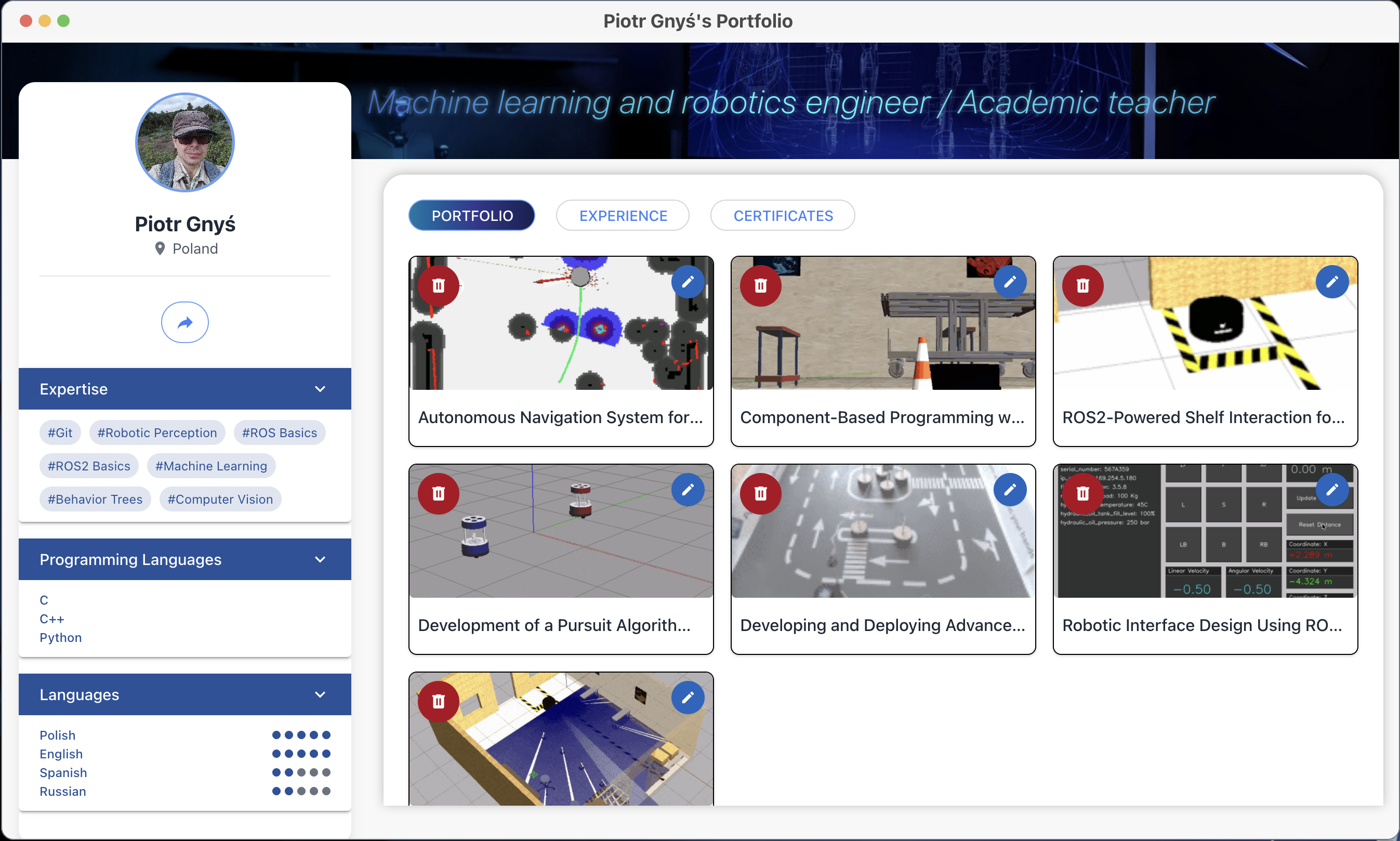
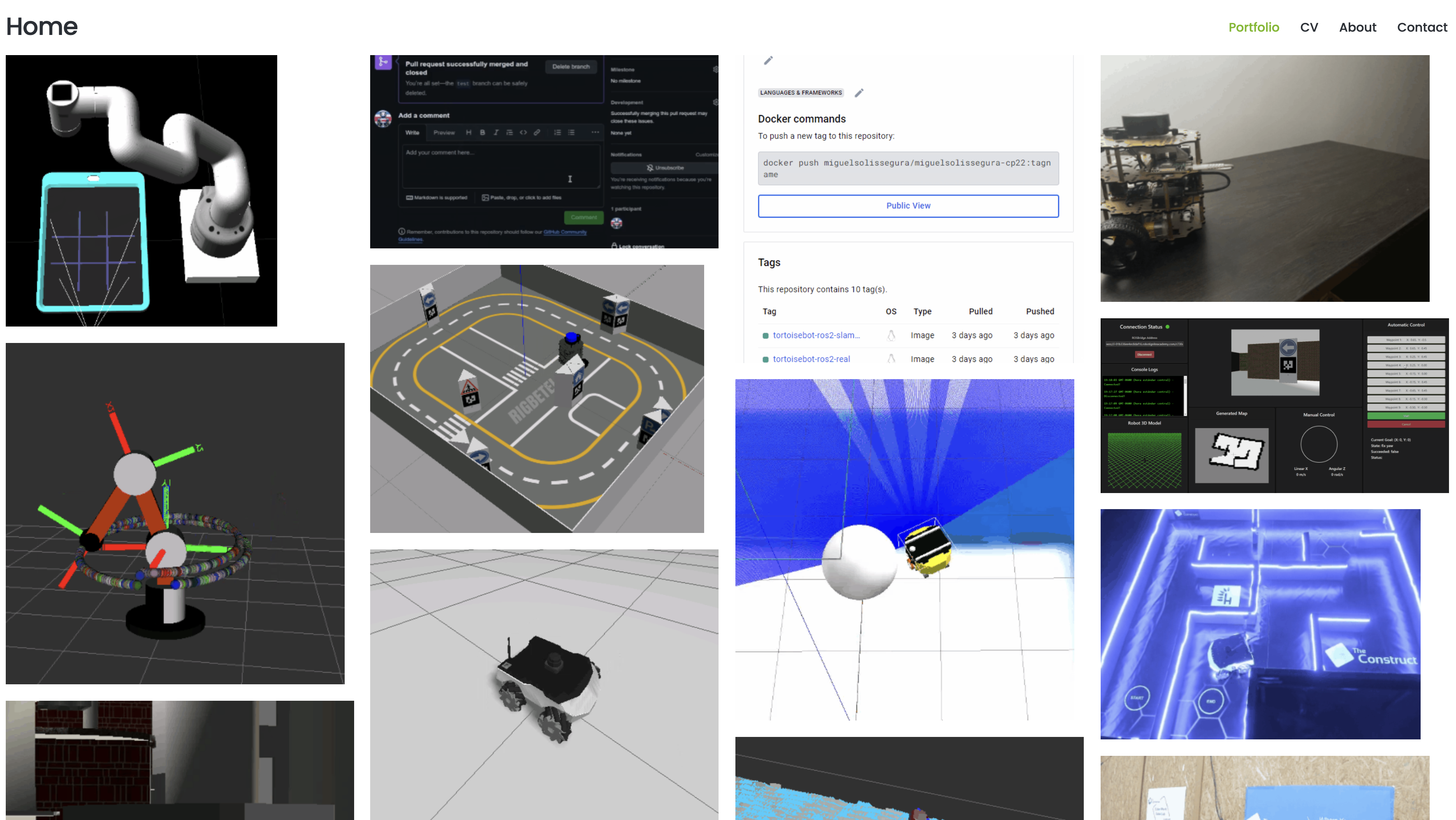
Some examples of successful portfolios
Here are a few examples of good portfolios from former students of mine:
Now it is your time to start building your portfolio, and if you want me to review it and give you some feedback, write a comment with the address to your portfolio and I’ll take a look.
*Final recommendation: Try the automatic portfolio generation from The Construct Robotics Institute, which provides a professional portfolio page for showcasing your robotics projects.
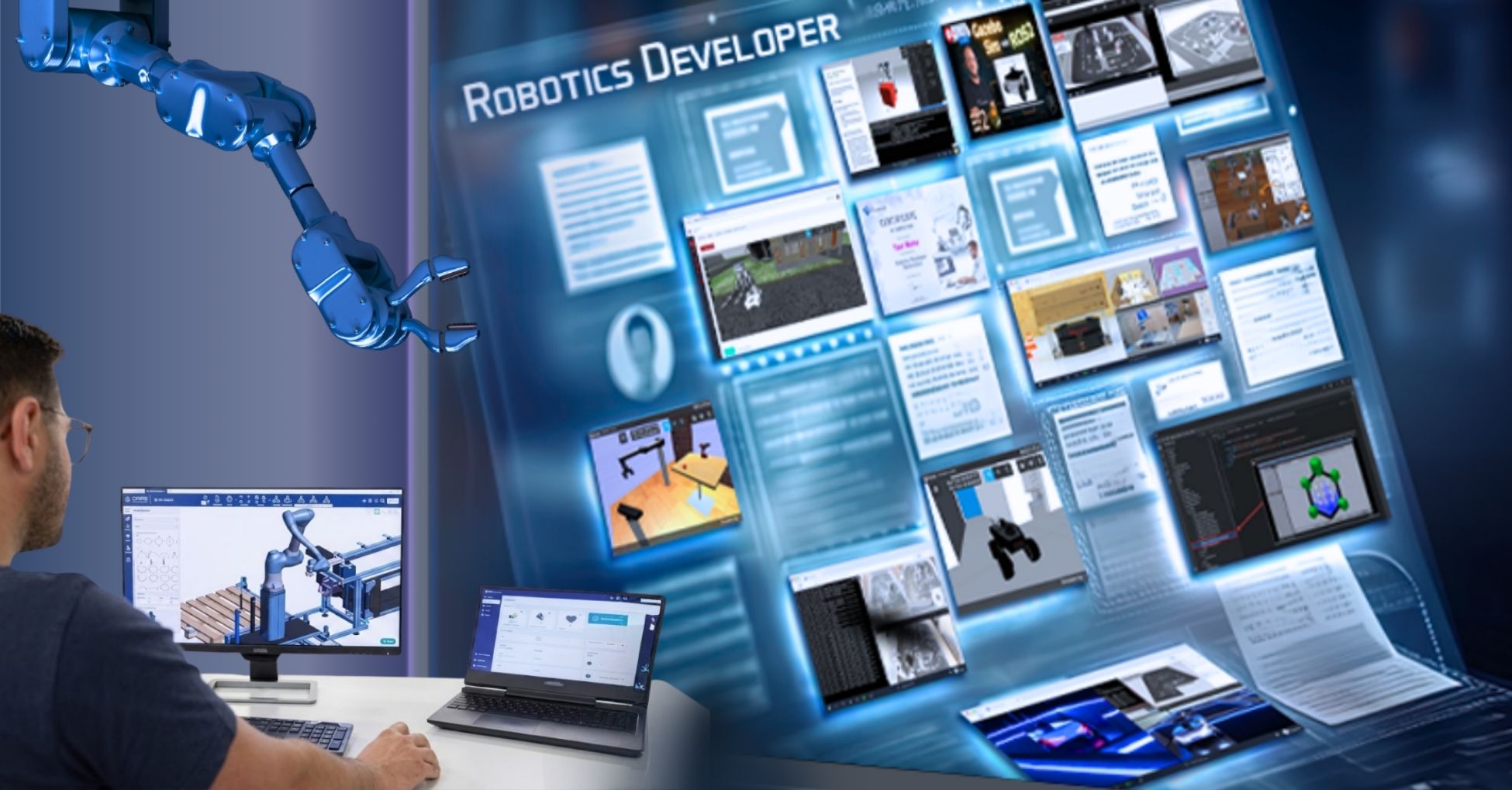
You can edit and fill the portfolio at will, but if you enrol in the Robotics Developers Masterclass, you will be doing awesome projects with simulations and real robots, and ALL THE PROJECTS ARE AUTOMATICALLY ADDED TO YOUR PORTFOLIO, including descriptions, links to code, and images.
Going to conferences (like ICRA, IROS, or specialized local meetups) is where you get the most leverage. You have to be proactive to make it count.
Phase
Action
Why it Works
Before the Event
Do Your Homework. Review the schedule, speakers, and attendee list (if available). Identify 3-5 specific people or companies you must meet. Research their recent papers or projects.
It turns a general meeting into a targeted, meaningful conversation. You have an intelligent talking point ready.
Before the Event
Reach Out (The Pre-Pitch). Send a brief, personalized email or LinkedIn message to the people you want to meet: “I really enjoyed your paper on [topic] and would love to chat briefly about it at the conference. Would you be open to grabbing a quick coffee?”
This breaks the ice and guarantees you a meeting, instead of relying on luck.
During the Event
Master the Elevator Pitch. Prepare a concise (30-second) summary of who you are and, more importantly, what you are currently working on (i.e., your portfolio project).
You sound confident and memorable. It quickly shows your value rather than just stating your job title.
During the Event
Ask Great Questions. Focus 80% on the other person. Ask about their work, challenges they are facing, or what they think the next big thing in the field will be. The goal is to be curious, not to sell yourself.
People love talking about themselves. This creates a positive, reciprocal relationship and makes you a good conversationalist.
During the Event
Utilize Poster Sessions and Socials. Poster sessions are great for detailed discussions with researchers. Attend the evening social events—these casual settings are where the best, unpressured connections are made.
It provides relaxed settings outside the formal presentations to build rapport.
During the Event
Be the Connector. Introduce people to each other (“Sarah, meet John. John is working on SLAM, and Sarah just presented a great paper on multi-robot path planning”).
Being a valuable connector makes you indispensable and memorable.
2. The Digital Ecosystem (The Consistency)
Networking doesn’t stop when the conference ends.2 You need to keep the conversation going and engage in online robotics communities.3
LinkedIn is Your CRM: Immediately after meeting someone, send a personalized LinkedIn connection request. Reference what you talked about: “It was great chatting about the challenges of hardware integration on the mobile robot you presented at ICRA.”
The Follow-Up is Crucial: Within 24-48 hours, send a brief, personalized email.4 Offer something of value first. – Bad: “Do you know of any job openings?” + Good: “Following up on our conversation about visual navigation, I found this great paper/tool that might interest you. Let me know what you think. If you ever need an extra pair of hands for an open-source contribution, I’m keen to help.”
Engage in Robotics Communities: Actively participate in places like robotics subreddits, ROS forums, and especially GitHub.5 Solving problems for others or giving insightful commentary establishes you as a knowledgeable and helpful peer.
Nurture Existing Contacts: Don’t just contact people when you need a job. Every few months, send a quick update on a cool project you finished or share an industry article relevant to their work. This keeps the relationship warm.
3. The Mindset Shift: Give Before You Take
The fundamental secret to successful networking is to stop thinking of it as transactional (What can this person do for me?) and start thinking of it as collaborative (How can I help or add value to this person?).
If you consistently show that you are competent, curious, and willing to help others, people will naturally want to refer you, collaborate with you, and ultimately, hire you.
So, You Want a Job in Robotics? Let me tell you something …
The robotics world is exploding, right? Everyone wants to be part of it. But let’s be honest, the old way of getting a job—just sending your resume—is not working anymore. Recruiters cannot manage the number of applications, and thanks to AI tools, they all look equally good (even if in reality they are not).Due to those AI tools, it is extremely difficult for employers to distinguish between the real robotics engineers and the Instagram ones (look cool but nothing really inside). If you are one of the fakers, just stop here, this post is not going to help you because it requires real work. On the other hand, if you are one of the real tough engineers, keep reading, I can give you some useful advice.To actually land your dream robotics job, you need to skip the typical path and get strategic. Here’s the insider’s guide to how to do it.
Forget the Diploma, Show What You’ve Built
I know what you’re thinking: “But I need a fancy degree!”Honestly, the general opinion is that degrees are becoming less and less important. Really. It is plenty of students that just got their degree and really know nothing. Those are what I call the Instagram profiles.What matters way more is having a good portfolio—a solid record of projects you’ve actually finished. Think of it as proof that you can do the work, not just talk about it.Your portfolio is your spotlight. Fill it with projects that excite you, whether you’re building actual robots (hardware is cool!) or programming them (software skills are key!). Every project, big or small, is a point of evidence of your skills.The portfolio allows the employer to see what you really know about it, and more importantly, ask you questions about it. You cannot fake a portfolio because if you do it, you will be caught during the questioning by your employer (afterall, if you did all those projects, you need to be able to answer the questions about it 😉Find here my advice about how to create the perfect robotics portfolio.
Go Open-Source: The Ultimate Resume Builder
Here’s a pro tip for leveling up your portfolio: contribute to an existing open-source robotics repository.Why? It’s not just about showing off your code and learning in the process. When you jump into an important existing repo, fix an issue, or add a feature, you’re proving a few things:
Teamwork: You show that you can work effectively in multi-cultural teams distributed all over the globe. That kind of collaboration skill is gold.
Credibility: If your code gets accepted, your name is forever attached to that project. It’s a permanent, public demonstration that you truly know your craft—which is far more powerful than any bullet point on a CV.
Some interesting repos to contribute, related to robotics:
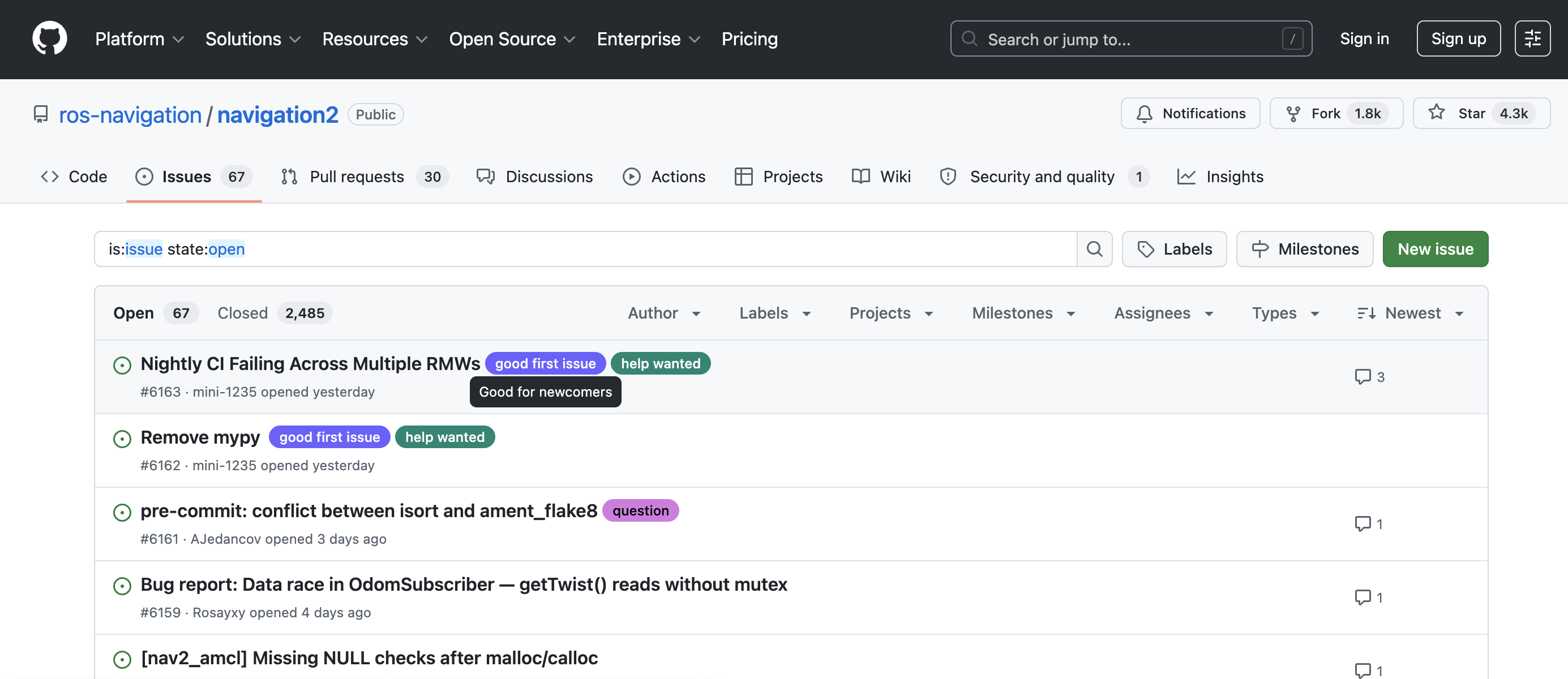
If you like making autonomous robots, contribute to ROS 2 Navigation
If you prefer to work on control, contribute to ROS 2 Control
If you like more robot arms and manipulation, Moveit 2
And if you prefer reinforcement learning for humanoids, mjlab
How to start contributing?Start simple. This means, visit the repo and get a local copy of it. Then go to the repo’s list of pending issues and search for #good-first-issue . This will provide you with a list of simple pending issues that you can start with. Select one and solve it. Then create a PR for it.Check this simple guide to learn how to do it: https://github.com/firstcontributions/first-contributionsNOTE: you will need to push the guys in charge of the repo to review and accept your issue. This is part of your job. Those guys are very busy so they will be reluctant to review it. That is how it works. Do not panic. Just push them. After all, they are happy somebody solved the bug.
You Gotta Master the Basics (and the Tools)
Even if I said that degrees are no longer a must, you can’t skip this part. You need to master all the basic knowledge in robotics. That means deep-diving into robotics theory (kinematics, control, etc.) and getting super comfortable with robotics programming (hello, ROS and Python/C++).Especially C++. You need to master it. You can never have enough of C++ knowledge. The more you know the better. Maybe you think that with AI tools it is not necessary to know that much C++. Wrong! AI tools are just a tool to speed you up, not to allow you to skip C++ mastering. You need excellent C++ skills because:
Companies will test you on this (without AI tools), and they are expecting you to know a lot of it, because it is the key to robust robots
Even if you use AI, you need to be able to identify where AI is wrong and that requires a lot of knowledge
But don’t stop there. You also need to be fluent in the modern developer toolkit:
Git for version control
Docker for consistent environments
Unit testing and functional testing for building reliable systems
These tools are non-negotiable for any serious robotics company, so you need to master them.
Ditching the Application Page: Two Paths In
Since sending your resume into the digital void doesn’t work anymore, you need to bypass the standard application page and connect directly with people. Here are your two best bets:
1. The Internship Hustle
This is the most direct route. Apply for an internship at a robotics company. Your goal is simple: get your foot in the door and demonstrate that you are the best employee they’ve ever had.
The Win: If you get a job offer afterward, awesome!
The Backup Plan: If you don’t, no worries! You’ve gained real experience. Include everything you’ve done in that internship as a huge, verified chunk of your portfolio. Most importantly, take advantage of the contacts you’ve made. Ask them, “Hey, who do you know at other companies that I should talk to?”. Then keep repeating the internship process.
2. Cultivate Your Connections (aka, Show Up)
The robotics industry is built on people. Hence, you need to cultivate your connections. That doesn’t mean that you need to work on LinkedIn and get as many contacts as possible. LinkedIn contacts are in the same Instagram category. They are fake. Useless to get a job. The only contacts that matter are the ones you make in real life (either interacting online, or interacting offline). Of all of the possibilities, offline connections are the best. So…
Go to the main conferences for the robotics subject you care about. Don’t just sit in the back! Here some recommendations:
ROSCon
RoboBusiness
Robotics Summit and Expo
European Robotics Forum
Nvidia GTC
IREX
Automatica
Interact as much as possible with as many attendants as possible. Shake hands, ask smart questions, and genuinely listen.
Cultivate your relationships with these people over time.
These relationships are where the best, unadvertised jobs come from. Getting a job in robotics today isn’t about what you know—it’s about who knows you and the cool stuff you can build. The Strategic Guide to Networking in Robotics
If the strategies above feel overwhelming,try this 6-month online program
The Robotics Developers Masterclass from The Construct Robotics Institute is an ONLINEtraining program created to bundle everything you need into one program:
Master the Basics & Tools: Comprehensive training in robotics theory, ROS 2, C++, and all the essential corporate development tools (Git, Docker, CI/CD, Jenkins).
Build an Unbeatable Portfolio: You work on several deep, hands-on projects, including a final Capstone Project, using simulated and real robots that form the cornerstone of your experience portfolio.
Stop trying to piece together your path—get the complete system.Learn more and get started at:roboticsdeveloper.ai