


Recently, a new trending topic has appeared in the robotics world: embodied AI. It is commonly used to describe a robot running AI algorithms.
I want to clarify that this is not what embodied AI actually means.
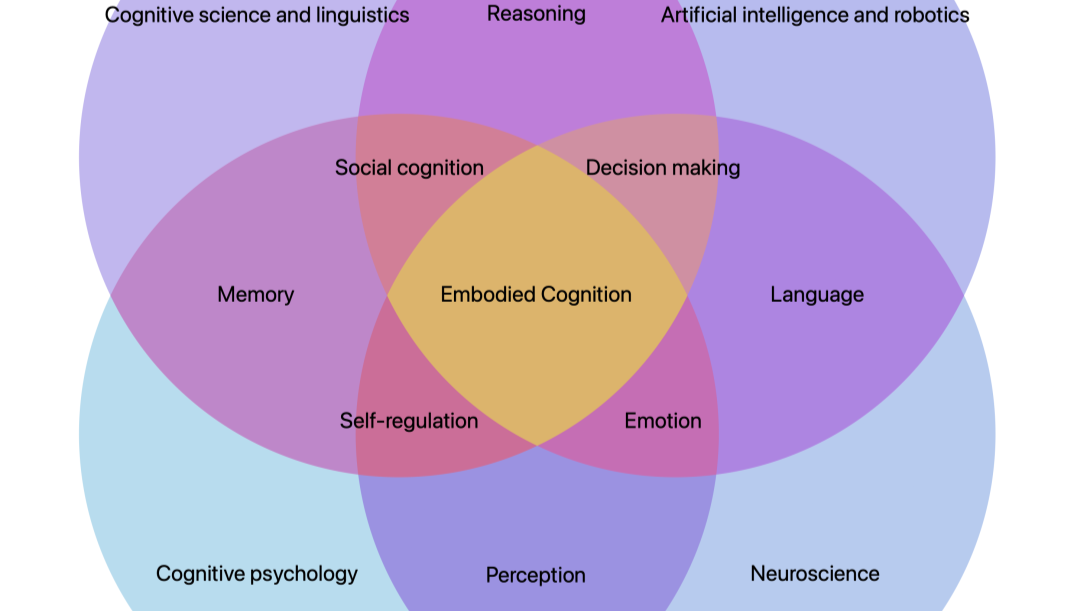
Artificial intelligence has existed as a field for more than 75 years. Early AI pioneers believed that intelligence could be achieved purely through algorithms. A physical body was considered irrelevant; only software mattered. The hardware running that software was considered unimportant as long as it could reproduce the intelligent algorithm.
This is still the dominant viewpoint among AI researchers today: AI is just software running on hardware whose specific physical form is not important, as long as it executes the algorithm.
However, due to the lack of meaningful progress in AI, a new trend emerged about 35 years ago, called embodied AI. The main premise of embodied AI was that intelligence is only possible if there is a body. True intelligence cannot arise from algorithms running inside a fixed, isolated box (like the AI portrayed in the movie Her). Instead, intelligence emerges from the continuous loop of interaction between the algorithm, the body that instantiates it, and the environment in which that body is immersed. Intelligence arises from this ongoing interaction among the three elements. I will call this approach EMBODIED AI (in capital letters).
In contrast, in today’s trending usage, researchers call embodied AI anything involving an AI algorithm running on a robot. That’s all. Getting images from the robot’s camera and detecting a person? Embodied AI. Using an LLM so the robot can talk to a person standing in front of it? Embodied AI. Using a lidar to navigate autonomously? Embodied AI. I will call this approach “embodied AI” (in quotation marks and lowercase).
Let me clarify:
- In “embodied AI”, researchers develop an algorithm independently of the robot and then place it on the robot to perform some task. A clear example is the current trend of LLMs. Training a model with millions of data points from the web and putting it into a robot so it can respond to people is not EMBODIED AI. For an LLM on a robot to be EMBODIED AI, it would need to emerge from the robot’s own interactions with the environment—not from an algorithm running on a GPU in the cloud, trained on YouTube videos or scraped websites.
- In EMBODIED AI, understanding—the basic ingredient of intelligence—can only be built from a body’s interactions with its environment. Having a body that can act on the world and perceive how its perceptions change as a result of its actions is the foundation of an intelligent system. In fact, animal life is the only proven example of an intelligent system, and it always involves this interaction loop. Therefore, it is impossible to generate EMBODIED AI using only web data, because such data contains no actions from the robot itself—only passive perception processed by an algorithm.
The problem is that, at present, nobody knows how to build an LLM-like system based on a physical robot interacting with its environment.
Therefore, I conclude that the trendy term everyone is using today is not EMBODIED AI, but merely “embodied AI”, or better said, just plain AI on a robot. Using the “embodied AI” term in this incorrect way is ultimately confusing and unproductive.
I know it sounds cool to say “I’m doing embodied AI,” but in the end, it is largely a marketing term—a new name for what has always been done (i.e., traditional AI). This kind of marketing cycle happens regularly in robotics and AI, just as it did with “edge computing” (simply running algorithms locally), “cobots” (robots with collision detection), or “digital twins” (simulations of real environments).
Naturally, I oppose this proliferation of terminology because it adds noise to an already difficult field, making it harder to build real AI (although, admittedly, I may eventually have to use these terms for business reasons).
To conclude, genuine EMBODIED AI is still supported by only a minority, since the prevailing view is that AI is just an algorithm. Some serious researchers who work—or have worked—on EMBODIED AI (and whose research does not receive the attention it deserves) include:
- Jeff Hawkins (from Numenta)
- Frederic Kaplan
- Pierre-Yves Oudeyer
- Jean-Christophe Baillie
- Kevin O’Regan
If you want a quick introduction to EMBODIED AI, read Embodied Cognition by Lawrence Shapiro.
In my ongoing effort to clarify the AI field, in future newsletters I will explain why AGI is just AI rebranded, why LLMs are essentially expert systems on steroids, and why “AI hallucinations” do not actually exist.

0 Comments