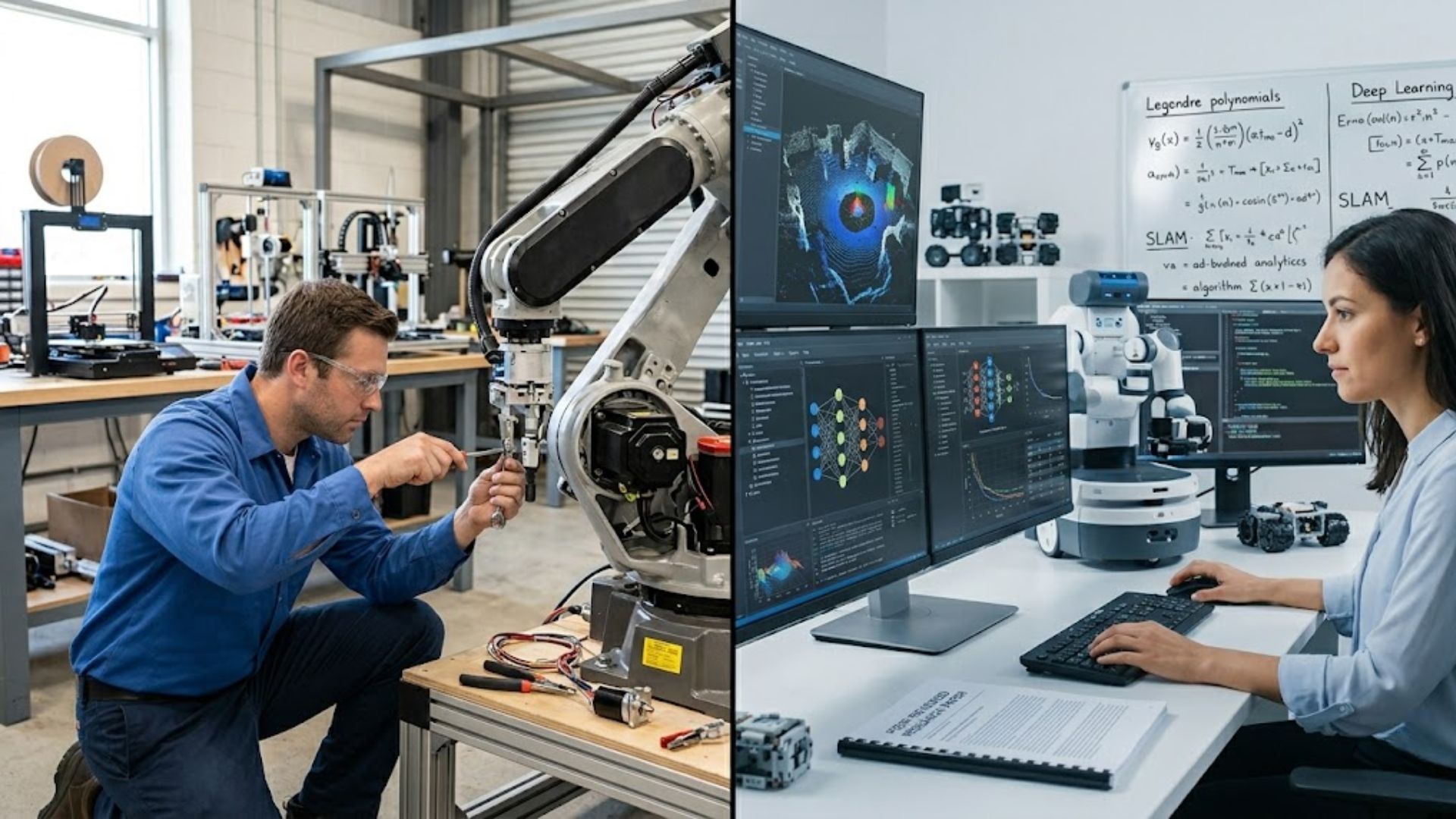

A lot of people say they want to “work in robotics” without realizing the field splits into two fundamentally different paths:
- Robotics Engineer
- Robotics Researcher
Same industry. Different incentives, tools, and career trajectories.
The Core Difference
A Robotics Engineer builds systems that ship.
Their job is to make robots operate reliably in the real world — under latency constraints, sensor noise, hardware failures, and unpredictable environments. They usually own a subsystem like perception, navigation, controls, or manipulation, and are judged by robustness and deployment.
A Robotics Researcher pushes the boundary of what’s possible.
Their job is to discover new methods, publish new findings, and solve problems nobody has solved before. Success is measured by novelty and research contribution, not production reliability.
Researchers expand the frontier.
Engineers turn the frontier into products.
Different Toolchains, Different Priorities
The difference shows up immediately in the tooling.
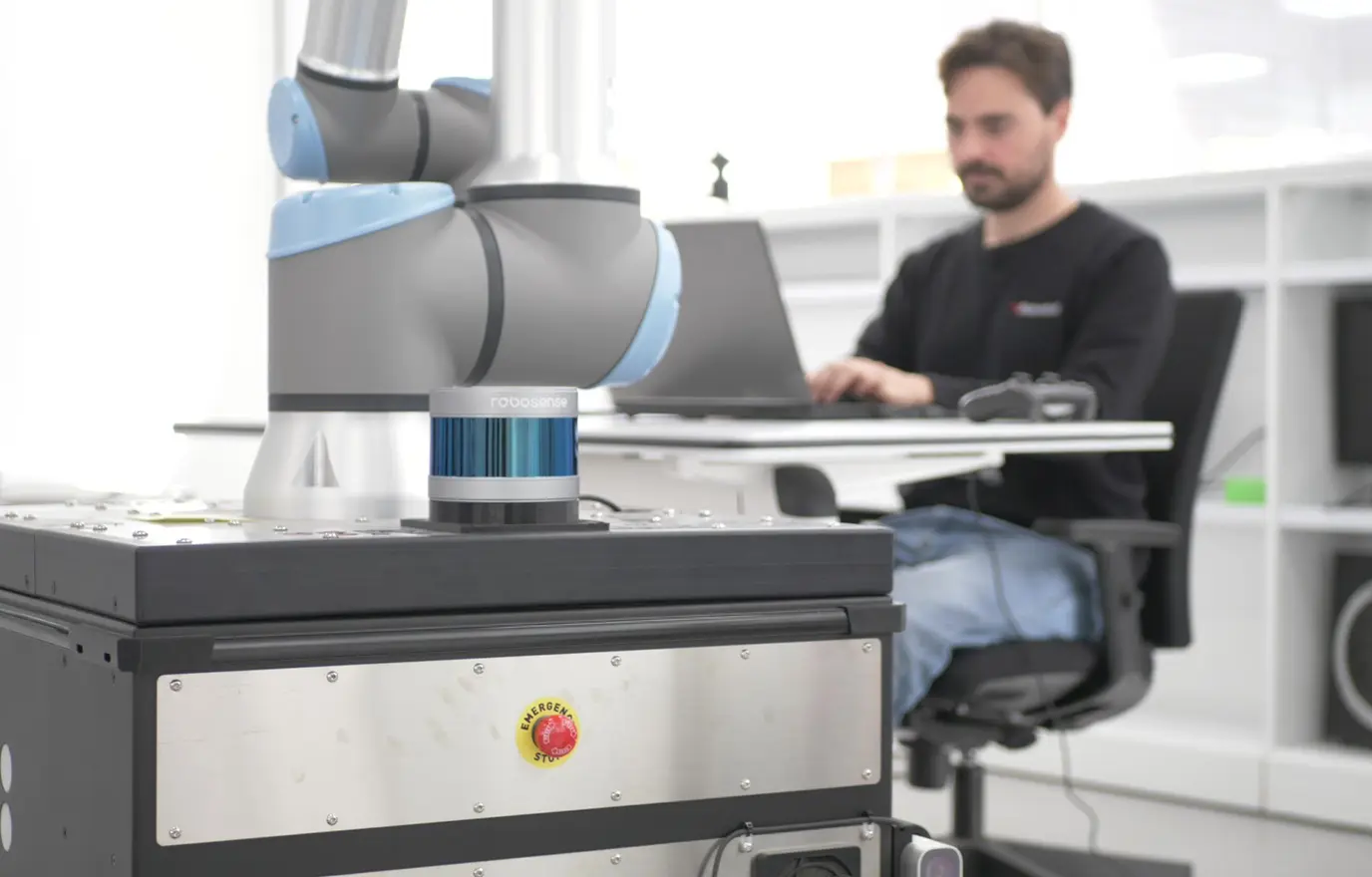
Robotics Engineers
The engineering stack is dominated by:
- C++
- ROS / ROS2
- Embedded systems
- Simulation pipelines
- Real-time systems
Why C++? Because deployed robotics systems need performance, determinism, and reliability. The code has to survive outside the lab.
A robotics engineer is optimizing for:
- latency
- robustness
- maintainability
- hardware integration
- production constraints

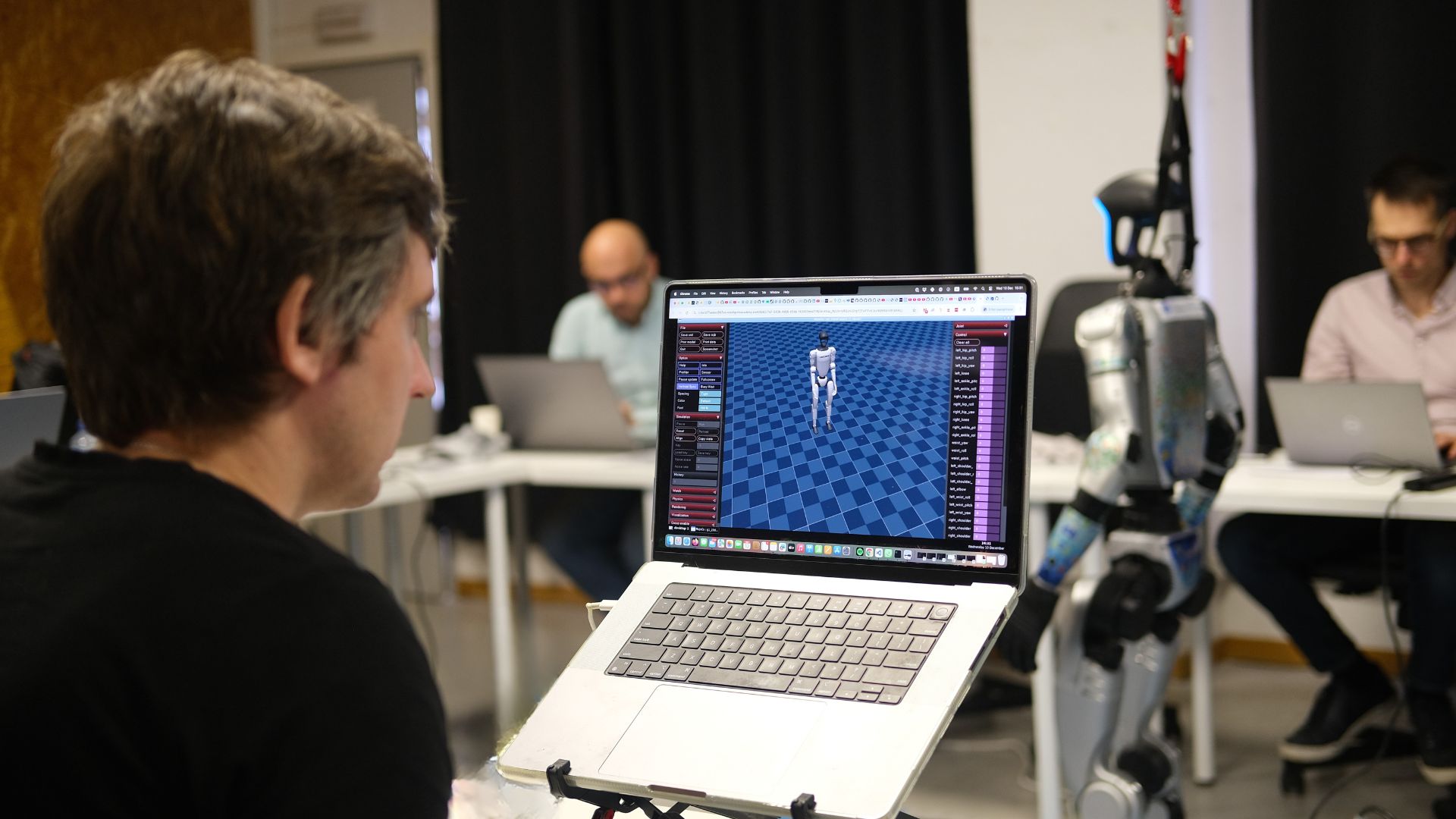
cr. Robotnik
Robotics Researchers
Research is largely Python-driven.
The goal is rapid iteration:
- test hypotheses
- validate ideas
- compare methods
- publish results
A proof-of-concept is often enough. The implementation does not need production-grade reliability — it needs to demonstrate that the idea works.
That’s why many research prototypes never make it into real-world systems without heavy engineering work afterward.
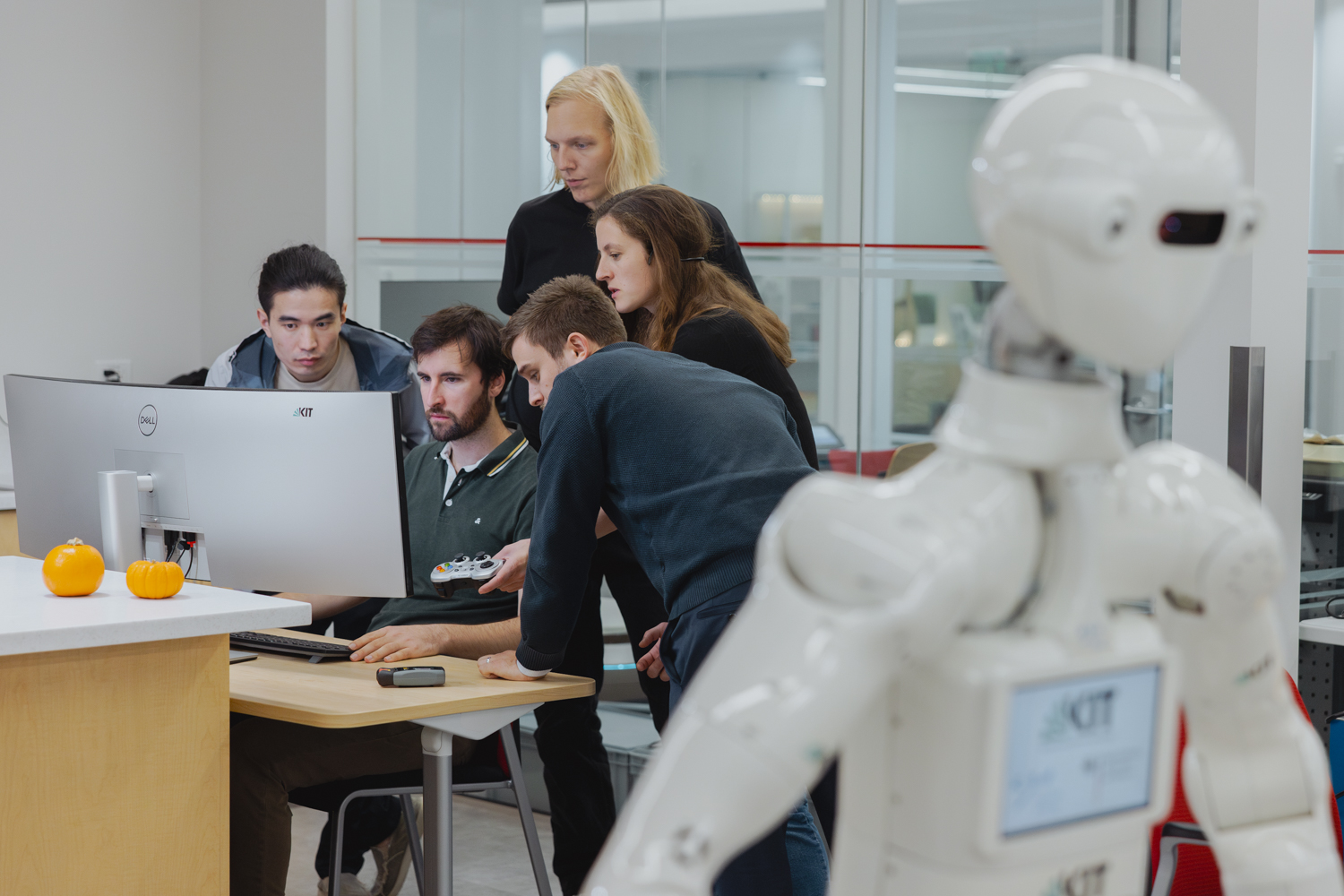
cr. Stanford Robotics Center
Education Requirements Are Not the Same
For Robotics Engineering, demonstrated skill matters more than credentials.
Strong candidates usually have:
- real robotics projects
- strong C++ fundamentals
- ROS experience
- simulation experience
- understanding of sensors, controls, and hardware
A degree helps, but it is no longer the main differentiator. Many strong engineers build their portfolio independently through open-source work, side projects, or competitions.
Research is different.
If you want to become a Robotics Researcher in a serious capacity, a PhD is effectively mandatory. Research hiring is tied to:
- publications
- citations
- peer review
- institutional credibility
Without a doctorate, access to top-tier research roles is extremely limited.
Where They Work
Robotics Engineers typically work in:
- robotics startups
- autonomous vehicle companies
- industrial automation
- defense
- warehouse robotics
- consumer robotics
Robotics Researchers are usually found in:
- universities
- research institutes
- corporate research labs
A small number work at elite industrial labs such as:
- Boston Dynamics
- Google DeepMind
- Toyota Research Institute
- NVIDIA Research Labs
Those roles are highly competitive and generally reserved for researchers with strong publication records.

cr. NVIDIA Newsroom
Compensation and Career Dynamics
Engineering generally pays better.
Senior robotics engineers in industry can reach compensation levels that exceed many academic research positions, especially in high-growth sectors like autonomous systems and AI robotics.
Research careers trade compensation for intellectual freedom and frontier work.

cr. CarrersInRobotics
Another reality: the larger the institution, the smaller your individual ownership tends to become. In large labs and corporations, work is distributed across many teams and contributors.
Smaller environments often provide:
- faster responsibility growth
- more ownership
- broader technical exposure
- clearer individual impact
Which Path Fits You?
Choose Robotics Engineering if you want to:
- build deployable systems
- work directly with hardware
- optimize for real-world reliability
- ship products used by customers
Choose Robotics Research if you want to:
- develop new algorithms
- publish papers
- explore unsolved problems
- advance the state of the field
Neither path is better.
But choosing the wrong one wastes years.
The earlier you understand the distinction, the more intentionally you can build your skills, portfolio, and career direction.
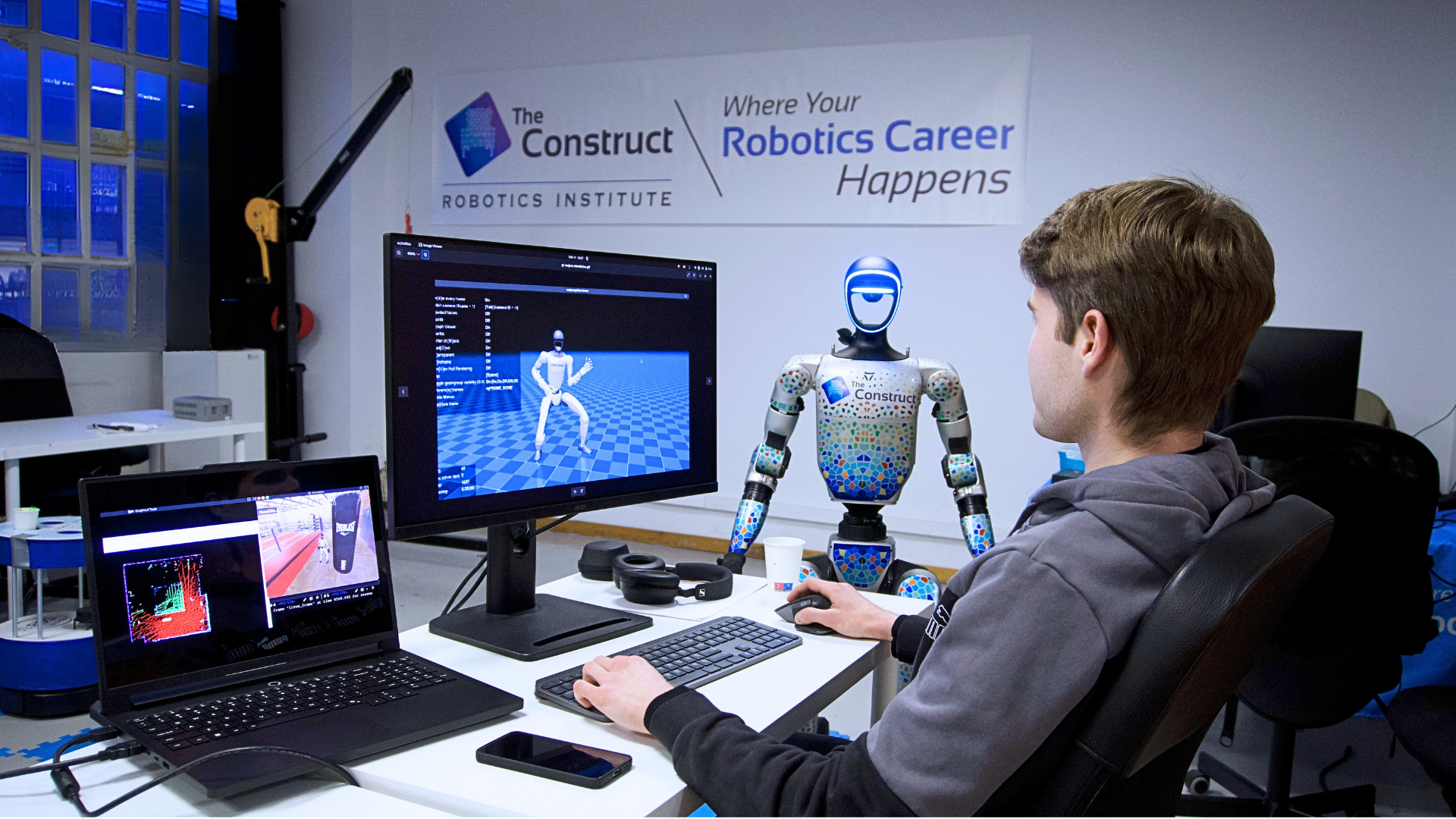
Whichever path you’re building toward, The Construct gives you the hands-on robotics foundation to get there faster.
The Robotics Developer Masterclass program is designed to help you build the exact skills, projects, and portfolio needed to enter the robotics job market confidently.
The program provides:
- Structured robotics learning paths
- Hands-on real-world projects
- Portfolio-ready systems
- Practical engineering guidance
- Industry-focused training
Instead of spending years wondering what to build next, you’ll follow a clear roadmap designed to help you become job-ready faster.
More Info & Enroll at: https://www.theconstruct.ai/robotics-developer/
0 Comments