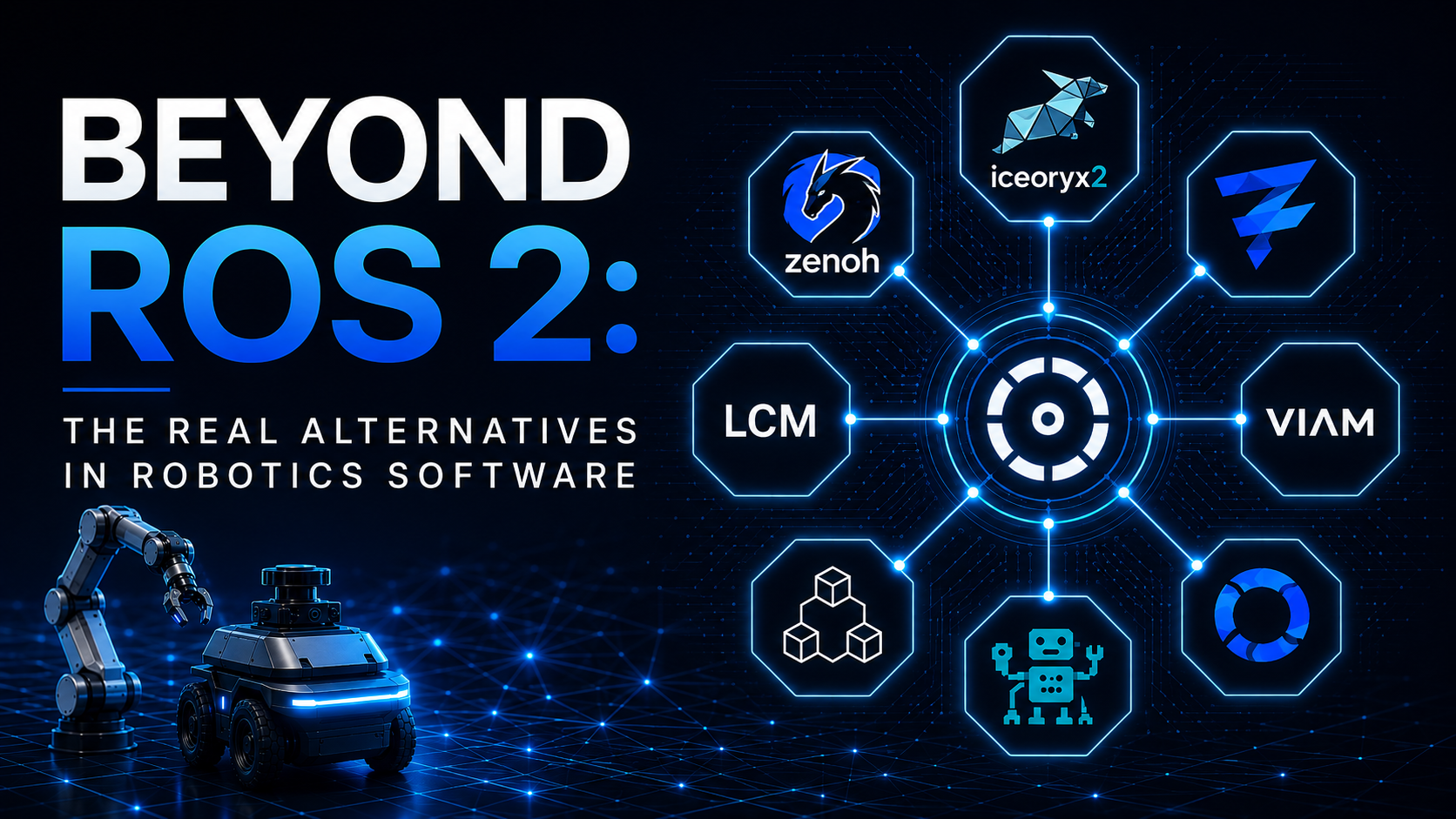

ROS 2 remains the default starting point for most robotics teams, and for good reason: it bundles a pub/sub communication layer, a large package ecosystem, and a mature tooling suite (rviz, rqt, launch files, colcon) into one open-source stack. But “default” doesn’t mean “only option.” As robotics has moved from research labs into automotive, industrial, and cloud-connected commercial products, a distinct set of systems has emerged — some competing with ROS outright, others quietly replacing just one layer of it.
This article surveys the real alternatives: communication middleware, full software frameworks, and cloud-native platforms that teams reach for instead of, or alongside, ROS 2. It deliberately excludes simulators (Gazebo, Webots), perception libraries (OpenCV), and robot-specific vendor SDKs that don’t touch the communication/orchestration layer — those solve different problems and aren’t ROS substitutes.
What ROS 2 Actually Provides — and Why Teams Look Elsewhere
ROS 2’s core contribution is a node graph: independent processes (“nodes”) that publish and subscribe to typed messages over topics, built on top of the Data Distribution Service (DDS) standard. Around that core sits a hardware abstraction layer, a build system, and thousands of community packages for navigation, manipulation, and perception.
Teams look for alternatives for a handful of recurring reasons:
- Real-time and safety certification. DDS-based ROS 2 has improved determinism significantly over ROS 1, but it isn’t certified for safety-critical use out of the box. Automotive (ISO 26262) and aerospace (DO-178C) programs need certified components, which ROS 2 alone doesn’t provide.
- Resource-constrained or embedded targets. DDS discovery and serialization carry overhead that’s unwelcome on small microcontrollers or tightly resource-budgeted systems.
- Cloud-native and fleet operations. ROS 2 was designed around LAN-scale node graphs, not internet-scale fleets of commercial robots needing remote monitoring, OTA updates, and centralized data management.
- Avoiding DDS complexity. DDS’s discovery protocol and QoS configuration are powerful but notoriously fiddly; some teams want a simpler communication layer.
- Licensing and vendor independence. A handful of teams prefer to own their stack outright rather than depend on the ROS ecosystem’s release cadence and governance.
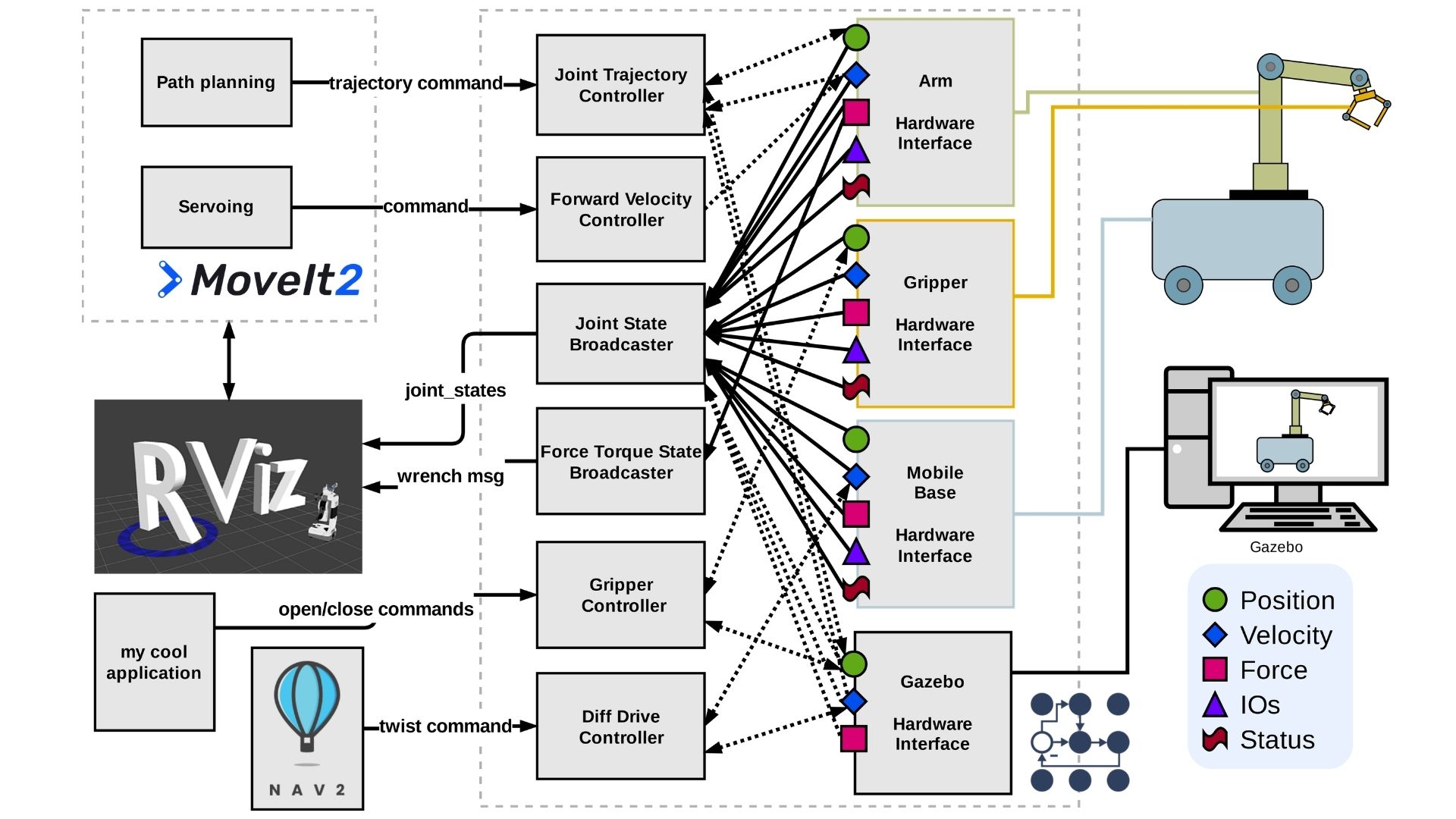
Credit: ROS2_Control
Evaluation Criteria
The systems below differ along a few axes that matter more than surface-level popularity:
- Communication paradigm — pub/sub, zero-copy shared memory, gRPC/RPC-style, or custom.
- Real-time / determinism — soft real-time, hard real-time, or none.
- Safety certification — whether the system (or a vendor’s build of it) carries formal certification like ASIL D.
- Network scope — single host, LAN, or WAN/cloud-native.
- Language support — which languages have first-class bindings.
- Licensing — open-source vs. commercial.
- Scope — whether it’s a full framework (comms + tooling + ecosystem) or just a communication layer meant to plug into something else, often ROS 2 itself.
That last point turns out to be the most important distinction in practice, and it’s easy to miss: several of the most-discussed “ROS alternatives” are not clean-room replacements at all.
The Alternatives
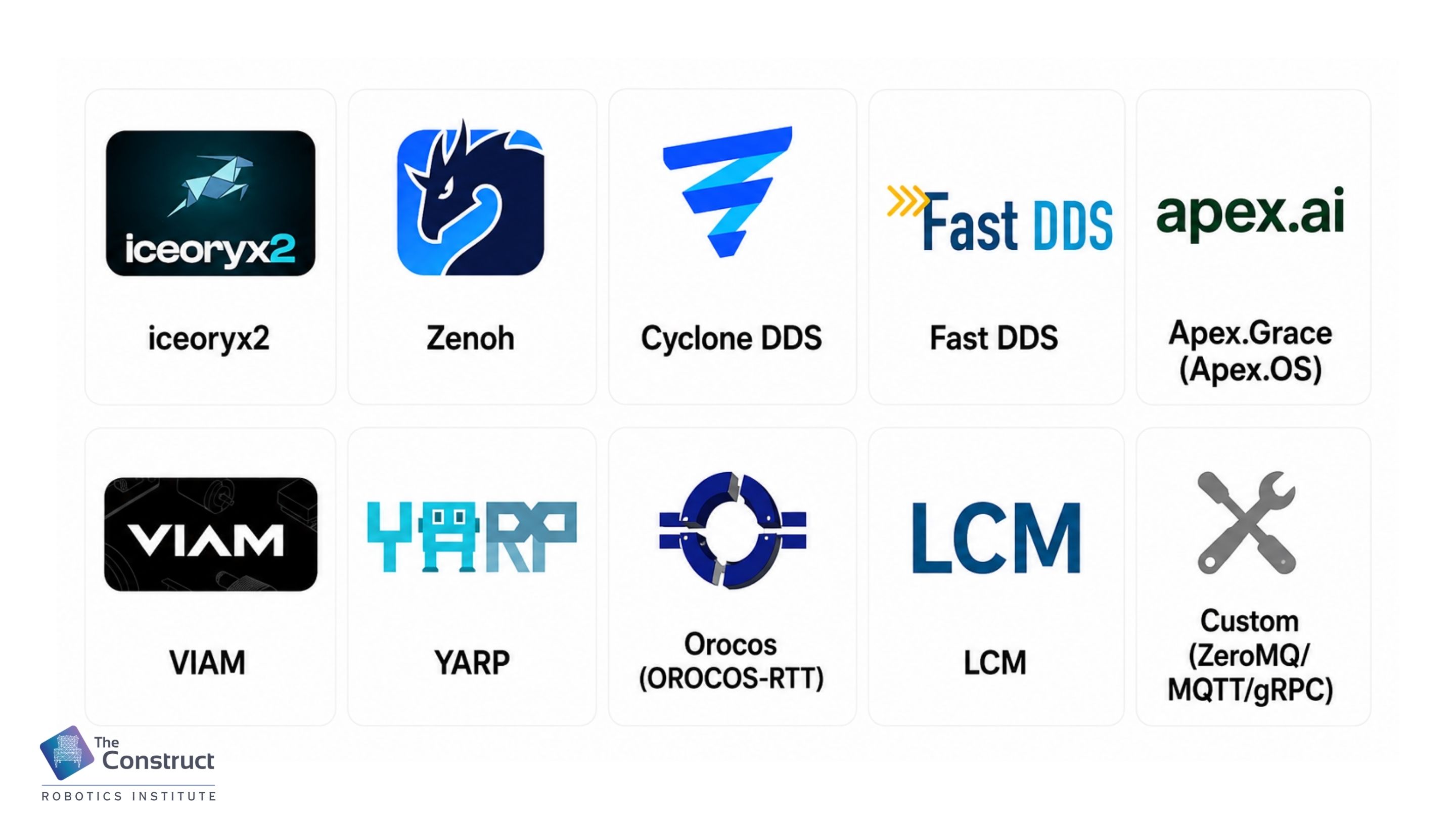
Eclipse iceoryx / iceoryx2
iceoryx is a zero-copy, shared-memory IPC middleware that originated in the automotive industry (Bosch) for high-bandwidth driver-assistance data. iceoryx2 is a from-scratch Rust rewrite aimed at improved memory safety and easier safety certifiability, with C++ bindings available.
Its defining trait is transmitting data from publisher to subscriber without ever copying it, giving constant, near-nanosecond latency regardless of payload size. The catch: iceoryx2 currently only supports communication within a single host, though cross-host “Gateway” and “Tunnel” mechanisms (bridging to something like Zenoh) are on the roadmap.
Importantly, iceoryx has a dual identity. It isn’t purely a ROS competitor — it’s also embedded inside ROS 2 itself, since Cyclone DDS uses iceoryx internally for shared-memory transport, and a dedicated rmw_iceoryx2 package lets ROS 2 use iceoryx2 as its middleware layer directly. So a team can adopt iceoryx2 either standalone (bypassing ROS entirely) or as a performance upgrade underneath their existing ROS 2 code.
Best fit: ultra-low-latency intra-process communication, e.g., high-frequency sensor or control loops on a single machine.
Zenoh
Zenoh, developed by ZettaScale, is a pub/sub/query protocol designed to scale from constrained microcontrollers up through edge devices to the cloud — a range DDS was never built for. It’s gained particular traction as an alternative ROS 2 RMW implementation, and recent ROS 2 releases (Kilted Kaiju, for example) have highlighted Zenoh as often running faster than traditional DDS while simplifying network setup for complex, multi-robot deployments.
Like iceoryx, Zenoh can be used two ways: as a full standalone communication layer for edge-to-cloud robotics systems that never touch ROS, or as a drop-in RMW swap for teams that want to keep ROS 2’s ecosystem and tooling but get better networking underneath.
Best fit: distributed or multi-robot systems that need to span local edge devices and cloud infrastructure, or as an upgrade to ROS 2’s default middleware.
Eclipse Cyclone DDS / eProsima Fast DDS
These are standalone, standards-based DDS implementations — usable entirely independent of ROS. Cyclone DDS combines network and intra-platform communication and uses iceoryx internally for shared-memory transport; Fast DDS is eProsima’s implementation, with safety-certified variants available commercially. Both are, notably, also the most common default middleware choices inside ROS 2 — Cyclone DDS in particular is the recommended RMW for Nav2, ROS 2’s navigation stack.
Teams that want DDS’s decentralized discovery and QoS guarantees — an industry standard used in aerospace and defense — without adopting the rest of ROS 2’s tooling and package ecosystem can build directly on either of these.
Best fit: teams that want standards-based, certifiable pub/sub middleware without full ROS 2, or who are choosing which RMW to run underneath ROS 2 itself.
Apex.Grace (formerly Apex.OS)
Apex.AI’s Apex.Grace is best understood not as a clean alternative to ROS 2 but as a hardened, certified fork of it. It’s a ROS 2-compatible SDK reworked for hard real-time behavior — static memory allocation at boot instead of ROS’s dynamic allocation, a deterministic executor, and removal of locking patterns that introduce jitter — and it holds ISO 26262 ASIL D certification from TÜV Nord, the highest level of automotive functional safety.
Apex.AI positions it explicitly as a migration path: prototype on standard ROS 2, then move to Apex.Grace for production automotive or other safety-critical deployment, ideally without a full rewrite. A companion product, Apex.Ida (formerly Apex.Middleware), handles certified communication. Because it’s commercial and proprietary, it targets OEMs and Tier 1 suppliers rather than hobbyists or research labs.
Best fit: automotive and other safety-critical systems that need ASIL D certification while retaining ROS 2 compatibility and workflow.
Viam
Viam is the most architecturally distinct entry on this list — a genuine departure rather than a layer swap. Instead of DDS-based pub/sub, Viam uses gRPC for structured, language-agnostic APIs and WebRTC for low-latency peer-to-peer streaming, explicitly built for cloud-connected operation rather than local-network-only communication. It bundles fleet management, data capture and sync, motion planning, computer vision, and SLAM behind consistent APIs, with SDKs in Python, Go, TypeScript/JavaScript, and C++.
Viam doesn’t require ROS and is pitched as sufficient on its own for new robot builds, but it’s explicitly modular — it can run alongside an existing ROS or ROS 2 system, integrating with it rather than replacing it outright, which is common for teams migrating gradually or adding fleet/cloud capabilities to an existing ROS-based robot.
Best fit: new commercial robots that need cloud connectivity, remote fleet management, and multi-language application code, without inheriting ROS’s assumptions about local-network pub/sub.
YARP (Yet Another Robot Platform)
YARP predates ROS and remains actively used, most notably as the backbone of the iCub humanoid robot platform. It provides pub/sub-style communication through “ports” along with RPC-style calls, primarily in C++ with bindings for other languages. It’s not designed for hard real-time control, and its ecosystem is far smaller than ROS 2’s, but it remains a sensible choice for teams with existing YARP-based codebases rather than a reason to start fresh.
Best fit: humanoid or research robotics groups with established YARP investments.
Orocos (OROCOS-RTT)
Orocos is a component-based real-time control framework, genuinely designed for hard real-time execution rather than approximating it. It’s frequently paired underneath ROS or ROS 2 — Orocos handling low-level, deterministic joint or motor control loops while ROS handles higher-level task orchestration and tooling — rather than used as a full standalone replacement.
Best fit: low-level real-time control loops, often as a complement to a higher-level ROS-based system rather than an outright substitute.
LCM (Lightweight Communications and Marshalling)
LCM is a minimal, UDP-multicast-based pub/sub library with bindings across C, C++, Python, Java, and others. It has none of DDS’s QoS machinery or discovery complexity — which is precisely its appeal for teams that find ROS 2’s middleware heavier than they need.
Best fit: simple logging and inter-process communication where DDS overhead isn’t justified.
Lingua Franca / HPRM and Other Academic Approaches
A newer academic direction worth flagging: coordination languages like Lingua Franca, which treats time as a first-class element of the programming model to guarantee deterministic behavior across distributed components. HPRM (High-Performance Robotic Middleware), built on Lingua Franca, has published benchmarks claiming order-of-magnitude latency improvements over ROS 2 for large-message broadcast scenarios. These remain research-stage rather than production-proven, but they signal where deterministic, timing-first middleware design is heading.
Microsoft Robotics Developer Studio
For historical context only: Microsoft’s Robotics Developer Studio was a Windows-based robotics framework active in the late 2000s and early 2010s. It’s long deprecated and effectively irrelevant today, but it’s occasionally referenced as an example of a full-framework alternative that didn’t survive ROS’s rise to dominance.
Bare Custom Stacks (ZeroMQ, MQTT, raw gRPC)
Some teams skip frameworks entirely and build a minimal communication layer directly on ZeroMQ, MQTT, or gRPC. This trades away tooling, message-definition standards, and community packages for full control and minimal footprint — a reasonable choice for small, well-understood systems, but one that requires the team to rebuild, from scratch, much of what ROS or the frameworks above already provide.
Comparison Table
| System | Type / Scope | Communication Model | Real-Time / Determinism | Safety Certification | Network Scope | Language Support | License | Best Fit |
| ROS 2 | Full framework (comms + tooling + package ecosystem) | Pub/sub over DDS (pluggable RMW) | Improved via DDS QoS + PREEMPT_RT, not hard real-time by default | None out of the box | Single host to multi-robot LAN | C++, Python (community: Rust, Java) | Apache 2.0 | Default choice; research, prototyping, most commercial robots |
| iceoryx2 | Standalone IPC middleware (also embeds inside ROS 2 via Cyclone DDS) | Zero-copy shared memory, pub/sub | Sub-microsecond latency, deterministic on single host | Designed for certifiability, not yet certified | Single host only (cross-host bridging in progress) | Rust (core), C++ bindings | Apache 2.0 / MIT | Ultra-low-latency intra-process comms |
| Zenoh | Standalone pub/sub/query protocol (also usable as ROS 2 RMW) | Pub/sub + query/reply, scalable routing | Low latency, not hard real-time | None | Single host to WAN/cloud | C, C++, Python, Rust, Java | Apache 2.0 / EPL 2.0 | Distributed/multi-robot systems spanning edge and cloud |
| Cyclone DDS / Fast DDS | Standalone DDS implementations (also ROS 2’s default RMWs) | Pub/sub, full DDS QoS | Good latency; Cyclone integrates iceoryx | Fast DDS has certified commercial variants | LAN/WAN, standards-based | C, C++, Python, Java | Eclipse/Apache-family | DDS without full ROS, or swapping ROS’s middleware |
| Apex.Grace (Apex.OS) | Certified fork/hardening of ROS 2 | Same as ROS 2, reworked for determinism | Hard real-time: static allocation, deterministic executor | ISO 26262 ASIL D (TÜV Nord) | Same as ROS 2 | C++, Python, Rust bindings | Commercial | Automotive/safety-critical production needing ROS 2 compatibility |
| Viam | Full cloud-native platform | gRPC (APIs) + WebRTC (streaming) | Not designed for hard real-time control | None | Internet-scale, multi-site fleets | Python, Go, TypeScript/JS, C++ | Commercial (free tier) | New commercial robots needing cloud/fleet management |
| YARP | Full framework, research lineage | Pub/sub + RPC-style ports | Not hard real-time | None | LAN, distributed | C++, with bindings | LGPL/BSD-style | Humanoid/research robots with existing YARP code |
| Orocos (OROCOS-RTT) | Real-time control framework | Component-based data flow | Genuine hard real-time | None | Primarily single-system | C++ | LGPL | Low-level real-time control, often under ROS |
| LCM | Minimal pub/sub library | UDP multicast pub/sub | Low latency, not guaranteed | None | LAN | C, C++, Python, Java, Lua, MATLAB | LGPL/BSD | Lightweight comms without DDS overhead |
| Custom (ZeroMQ/MQTT/gRPC) | Roll-your-own | Whatever you build | Depends on implementation | None unless self-certified | Whatever you build | Whatever you choose | Depends | Small/simple systems avoiding framework overhead |
Decision Guidance
- Need ASIL D automotive certification? Apex.Grace — it keeps ROS 2 compatibility while adding the certification and determinism guarantees ROS 2 lacks natively.
- Want a ROS 2 drop-in performance upgrade without changing your architecture? Swap the RMW layer to Zenoh or iceoryx2 (via rmw_iceoryx2), or select Cyclone DDS with shared-memory transport enabled.
- Building a new cloud-connected commercial robot with no legacy ROS investment? Viam’s gRPC/WebRTC-based platform and fleet management tooling are built for exactly this.
- Need the fastest possible communication on a single machine, full stop? iceoryx2 directly, bypassing any pub/sub framework overhead entirely.
- Have an existing YARP or Orocos codebase? Keep it — rewriting a working real-time control stack rarely pays off just to standardize on ROS.
- Need something simpler than DDS for a small, well-understood system? LCM or a bare ZeroMQ/MQTT layer.
Conclusion
The framing “ROS vs. its alternatives” is somewhat misleading. Several of the most significant names here — iceoryx2, Zenoh, Cyclone DDS, Fast DDS, even Apex.Grace — aren’t clean-room replacements at all. They plug into or extend ROS 2’s middleware layer, and in most cases a team can adopt them underneath an otherwise-standard ROS 2 system without discarding its tooling or package ecosystem.
The genuine full alternatives — Viam foremost among them, with YARP and Orocos as longer-standing options for specific niches — exist because ROS 2’s design assumptions (LAN-scale node graphs, DDS-based discovery, no built-in fleet or cloud layer) don’t fit every deployment target, particularly cloud-connected commercial products and safety-critical automotive systems.
In practice, the real decision most teams face isn’t “ROS or not” — it’s which single layer of the stack, if any, is worth swapping out, and whether that swap is worth losing access to ROS 2’s much larger community and package ecosystem in return. As this space moves quickly — Zenoh and iceoryx2 adoption inside ROS 2 itself is still evolving, and product names like Apex.OS/Apex.Grace have already changed once — it’s worth checking each project’s current status before committing to it for a production system.
But knowing which tools and frameworks exist is only the first step.
The real challenge is learning how to actually use them with real robots.
If you’re looking to take that next step and start a career in robotics, check out the Robotics Developer Masterclass.
It takes you from the fundamentals to building real robotics projects, giving you the hands-on skills companies are looking for. And you don’t need an engineering degree — just the motivation to learn and build.
Learn more about the Robotics Developer Masterclass: roboticsdeveloper.ai
0 Comments